


A recurring theme in my columns for The Contrarian has been not only the danger posed by incompetence and destructive policies of the Trump administration, but also by complacency and silence. I have argued that Pete Hegseth’s removal of unquestioned expertise and experience from the military’s senior ranks — whether driven by spite, insecurity, ideology or simple misjudgment — demanded a response from across government.
In September 2025, I focused particularly on retired general officers. Many undoubtedly understood what the removal of experienced commanders and the politicization of military leadership could mean for readiness. I argued that they needed to say so publicly — a difficult proposition given the military tradition of remaining outside partisan politics even after leaving uniform.
But that is not the argument I want to revisit here. The Iran war, and the accumulating evidence of the strain it is placing on American military readiness, has brought me back to a question I wrestled with during Trump’s first administration: Why do so many qualified and respected officials remain in senior positions when the president’s decisions and rhetoric are plainly at odds with their own judgment and, in some cases, their character?
There is a tendency among senior national-security officials — military and civilian — to imagine themselves as the last responsible adult in the room. If not me, who? If I leave, who keeps this from getting worse?
A number of officials from Trump’s first administration later described some version of that calculation. Former Defense Secretary Mark Esper said he repeatedly wrestled with whether to resign but remained in part because he feared that someone more compliant might replace him. John Kelly made a similar argument about his tenure as White House chief of staff, suggesting that his effectiveness should be measured partly by what Trump did not do while Kelly was there.
Then-Department of Homeland Security Chief of Staff Miles Taylor anonymously penned a New York Times opinion piece in September 2018 that said he was “part of the resistance” inside the administration. He argued that he had to stay “to thwart parts” of Trump’s agenda and “his worst inclinations.” Taylor later acknowledged that resigning might have sent a stronger message.
The rationale is understandable. Experienced officials can sometimes prevent the worst outcomes. I have shared that hope. Just last week, I wrote about CIA Director John Ratcliffe’s trip to Moscow in those terms.
But nothing in Trump’s tenure as president — in either term — tests that rationale as much as this administration’s prosecution of the Iran war. Six months into this conflict, 18 Americans have been killed and 757 wounded; the Pentagon only days ago added another 60 wounded personnel to its earlier official count of 697. The administration is seeking another $67 billion for the war.
Reporting last week said the war’s depletion of critical defensive and offensive munitions is affecting planning and deterrence requirements involving China and Russia, including inventories of air defense systems in Europe and Asia. More troubling still, U.S. intelligence reportedly assesses that Moscow may view that vulnerability as an opportunity to escalate against American interests and allies in Europe. Separate reporting indicates the purpose for Ratcliffe’s surprise visit to Moscow was to warn Russian President Vladimir Putin not to test NATO’s resolve, such as military provocation against one of the Baltic states.
Responsibility for these developments is not evenly distributed. Trump chose the policy. Hegseth administered it while continuing to remove or marginalize experienced military leaders.
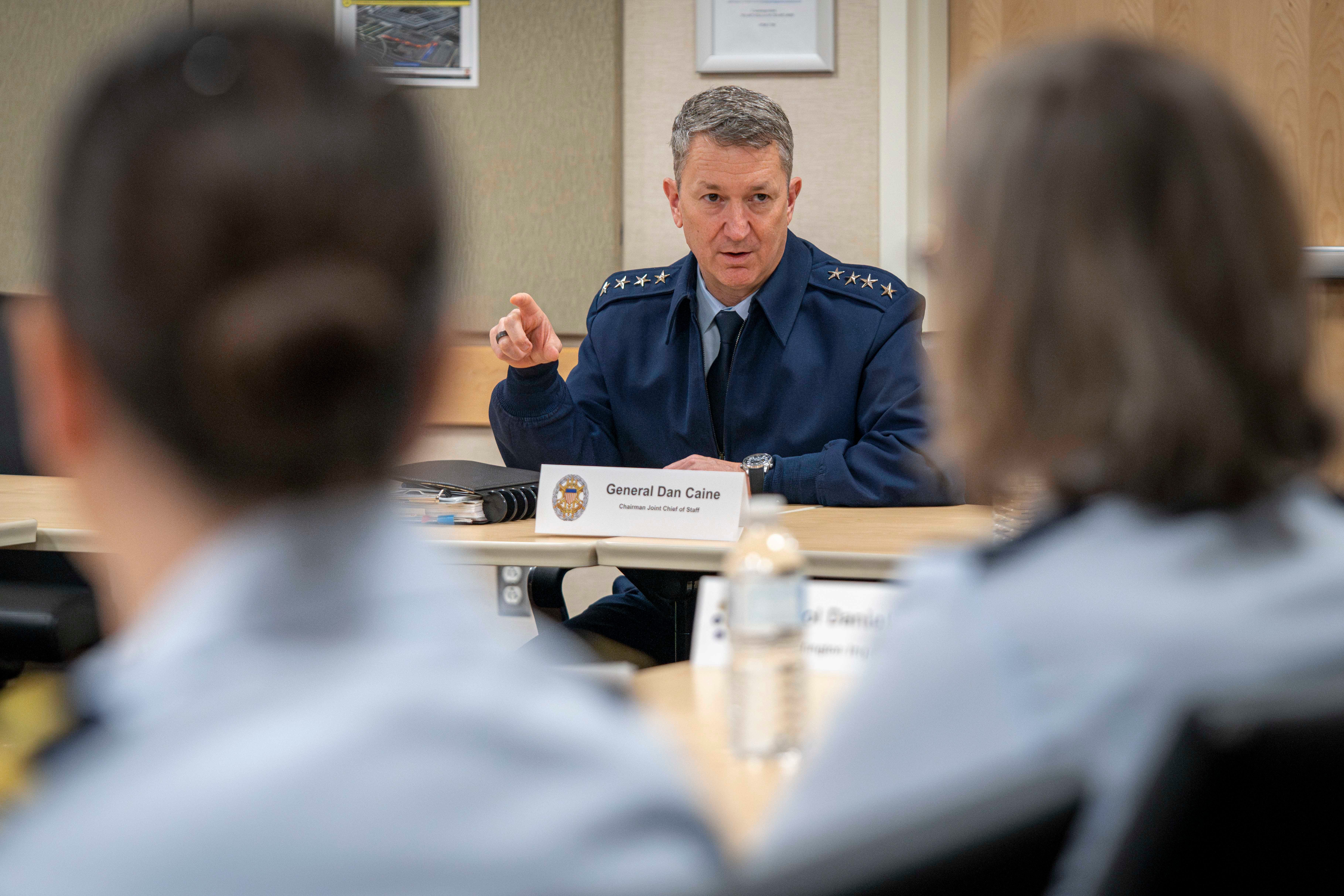
Chairman of the Joint Chiefs of Staff Gen. Dan Caine’s responsibility is different. His role as the president’s senior military adviser is to provide his best military judgment about the feasibility, costs, and risks of the policies the military is being directed to execute.
Before the war, Caine reportedly warned Trump that the United States lacked the munitions and allied support necessary for a prolonged conflict and that American personnel would face significant risks. This month, CNN reported that he has been searching for an “off-ramp,” arguing privately that escalation could backfire and that airpower alone is unlikely to achieve Trump’s objectives.
But there is another part of the story.
CNN also reported that Caine has been less direct with Trump than with other senior officials. One source familiar with their interactions said he was “pulling punches.” The same report described Caine as being mindful of maintaining his access to the president and careful in presenting military options and their consequences.
I am not suggesting that Caine has failed in his duties. However, if Caine has softened that judgment to preserve his access to Trump, then the issue is no longer simply whether he is the responsible officer in the room. It is whether preserving his place in that room has begun to compromise the very purpose of being there.
The distinction, therefore, is not between civilian failure and military innocence. Trump chose the course. Hegseth helped shape and administer it. Operational commanders and military institutions should be held accountable where planning, preparedness, or execution fell short. And Caine should be judged on whether his advice was sufficiently candid and forceful before and during a war whose consequences increasingly resemble the dangers he reportedly foresaw.
Perhaps Caine concluded that preserving his relationship with Trump was essential. Such a calculation would not be frivolous. Trump has demonstrated little reluctance to remove senior officials who challenge him.
But preserving access becomes harder to defend if doing so requires tempering the advice that access is supposed to make possible.
That is where the familiar “adult in the room” defense becomes more complicated. Officials from Trump’s first administration argued that remaining gave them opportunities to prevent worse decisions. In retrospect, some of those claims deserve more credit than they initially received. But the argument cannot become self-validating: The fact that a respected official remains close to the president cannot itself be evidence that he is exercising meaningful restraint.
Caine may have warned Trump. Or he may also have calibrated those warnings to preserve his influence with a president who dislikes contradiction. We cannot know from the outside where that balance lies.
Six months into this war, however, the difference between preserving access to influence the president and preserving access by softening unwelcome advice matters. The relevant question is no longer whether competent people remain in the room. It is what they have done with the influence their presence was supposed to provide.
Brian O’Neill, a retired senior executive from the CIA and National Counterterrorism Center, is an instructor on strategic intelligence at Georgia Tech. His Safehouse Briefing Substack looks at what’s ahead in global security, geopolitics, and national strategy.

I appreciate the nuance, Mr. O’Neill. We so often get just black or white judgments, when these don’t suffice in the real world. I know I say this frequently, but the same stay-or-go? dynamic extends to all federal employees. Given a choice to quit or stay and be harassed by Elon Musk and Trump in 2025, we faced an impossible decision, and our livelihoods were on the line. Much government work is proprietary, meaning the skills and expertise developed over time are not transferable to other sectors. And getting another well-paying job when in your 60s is probably not going to happen. Thanks to pay freezes and other circumstances, we were unable to save for a transition.
We all need an income. So now, whether to stay or go is no longer an ethical or moral issue but a survival one. This is the situation that DOGE meant to force; now it’s “we own you.” And that is very demoralizing indeed.
Just finished "Regime Change - Inside the Imperial Presidency of Donald Trump" by Maggie Haberman and Jonathan Swan, published on June 23rd. Excerpts from page 398 regarding Caine:
"So persistent was the chairman [Caine] in not taking a stand - repeating that it was not his role tell the President what to do, but rather to present options along with potential risks and possible second and third-order consequences - that he could appear to argue all sides of an issue simultaneously."
"Caine differed in almost every way from the Joint Chiefs chairman Trump's first administration, General Mark Milley, who had argued vehemently with Trump and who saw his role as stopping the President from taking dangerous or reckless actions."
"A close observer noted that Trump seemed to confuse tactical advice from Caine with strategic counsel."