


Tax the rich?
In California, a November ballot initiative would impose a one-time, five percent wealth tax on fortunes greater than $1 billion. The notion is more contentious than you might expect.
Prop 40 is splitting not just the working class from the billionaires, but the state’s Democratic Party from top California politicians, and rank-and-file staffers at progressive organizations like Planned Parenthood California from their leadership.
The measure is also becoming a national litmus test, as could-be presidential candidates begin jockeying for the 2028 Democratic nomination.
Here’s what you need to know.
Uber-rich, Undertaxed
The logic of a billionaire wealth tax is not hard to grasp. With the superrich, income-based taxation barely scratches the surface. Most billionaires don’t win or sustain their fortunes because of a high salary. (Some infamously take a nominal sum for regular income.) Instead, their billions come from appreciated assets, like shares of corporate stock, which don’t get taxed until they’re sold.
To avoid selling shares and triggering taxes — while still enjoying the megayacht lifestyle — billionaires rely on a relatively simple scheme. They borrow at low interest rates and live off that money, tax-free. A tax bill only comes due at death. Even then, loopholes, trusts, and accounting rackets mean these estates wind up lightly taxed.
With the stock market reaching record highs amid an AI-inflated tech boom, the wealth gap is widening. And Americans are fed up. Taxing billionaire wealth has become extremely popular, in the abstract. A recent poll asked about implementing a small national wealth tax on fortunes over $50 million, rising to 3 percent for billionaires. It registered 80 percent support, with even 72 percent of Republicans on board.
But the specifics of California’s Prop 40 have become contentious. And recent polling shows that the initiative is a jump ball, as ballots are now being cast in the Golden State.
Prop 40 is intended to make the state’s tech barons and other members of the ridiculously rich — about 250 households in all — share the wealth to fund public services in a state that, on paper, is richer than Japan. The ballot measure, sponsored by SEIU and backed by a bevy of other unions, is expected to raise as much as $100 billion. Its revenue would backfill cuts imposed by Trump’s “One Big Beautiful Bill,” with 90 percent to pay for health care and 10 percent for education and nutrition assistance.
Two U.C. Berkeley economics professors, Emmanuel Saez and Gabriel Zucman, are regarded as the intellectual godfathers of the tax. (They are director and co-director, respectively, of the university’s Center on Wealth and Income Inequality.) “The fight around Prop. 40 has literally become a fight between democracy and oligarchy,” Saez recently told a university publication, predicting that a successful taxation campaign in California could become a “turning point” in the battle against inequality, and is likely to be copied by other states and other nations. (Read the duo’s case for the tax here.)
Billionaire Backlash
No surprise: The state’s billionaires are crusading against the passage of Prop 40. The opposition has spent more than $200 million to defeat the measure, and the chief opponent is Google cofounder Sergey Brin, who has reportedly spent more than $100 million on the cause. Brin is worth about $260 billion and would be on the hook for roughly $13 billion if Prop 40 passes. Of note, Brin also appears in the Epstein files and in federal court documents as an alleged visitor to Epstein’s island. He reportedly also worked with Jeffrey Epstein on developing a tax-sheltered trust. (Brin has not publicly commented on these ties.)
The billionaires are pushing a narrative that the state’s wealthiest residents and their innovative businesses could leave California if the ballot measure passes. In other words, that Prop 40 could kill the state’s golden goose. A handful of billionaires — including Brin, fellow Google cofounder Larry Page, and Peter Thiel (also Epstein associates) — have supposedly moved out of state preemptively. Tax attorneys caution that the California revenue authorities have the power to conduct residency “audits” that may challenge the substantive nature of such relocations. (Zucman, the Berkeley professor, points out that the tax applies to the global wealth of anyone who lived in the state as of Jan. 1 of this year. In other words, for other billionaires eyeing the exit: “It is too late to move.”)
Strange Bedfellows
Prop 40 is dividing more than the Epstein class from the working class. The state’s Democratic Party supports the measure, but it is opposed by outgoing Gov. Gavin Newsom, a likely 2028 presidential contender, as well as the party’s gubernatorial nominee, Xavier Becerra.
Mainstream Democratic opponents insist they are not siding with the billionaires. But they do echo the argument that the wealth tax could disrupt the business climate in the state, and push wealth-generating startups out of Silicon Valley and into, say, Texas, Tennessee, or Florida. (A similar logic led the state to settle a lawsuit meant to block Paramount’s merger with Time Warner, after the Ellison family threatened, effectively, to uproot Hollywood and move to Nashville if they didn’t get their way.)
Governor Newsom has longstanding ties to the state’s billionaire class. His father was a lifelong friend and the tax attorney for oil billionaire Gordon Getty, who was a proto-father figure to the future governor and helped him launch and retain his wine business. Newsom has criticized Prop 40 as “damaging to the state,” warning it would leave California at a disadvantage, adding: “We live in a competitive reality with 49 other states.”
Newsom elaborated on his view in a recent Substack post. “Wealth is movable, and it shops for the state with the lowest taxes,” he argued. “The fight belongs at the federal level, where this broken system was created in the first place.” But Newsom’s policy fix is focused on income taxes — including taxing the borrowed money that billionaires live on as income, and imposing a minimum income tax rate on billionaires. When it comes to taxing wealth, he only (vaguely) calls for strengthening the estate tax, asking that the nation “rewrite our inheritance rules” or risk locking in “a permanent American aristocracy of inherited wealth.”
The Democratic nominee for governor, Becerra, has also spoken out against Prop 40, but on more technocratic grounds — arguing it is flawed because it provides a one-time windfall rather than ongoing revenue. The rationale behind Planned Parenthood’s opposition is similar. Several unions have also come out against the measure, broadly because they object to the lopsided health-care focus of the revenue distribution.
A Stand Against Oligarchy
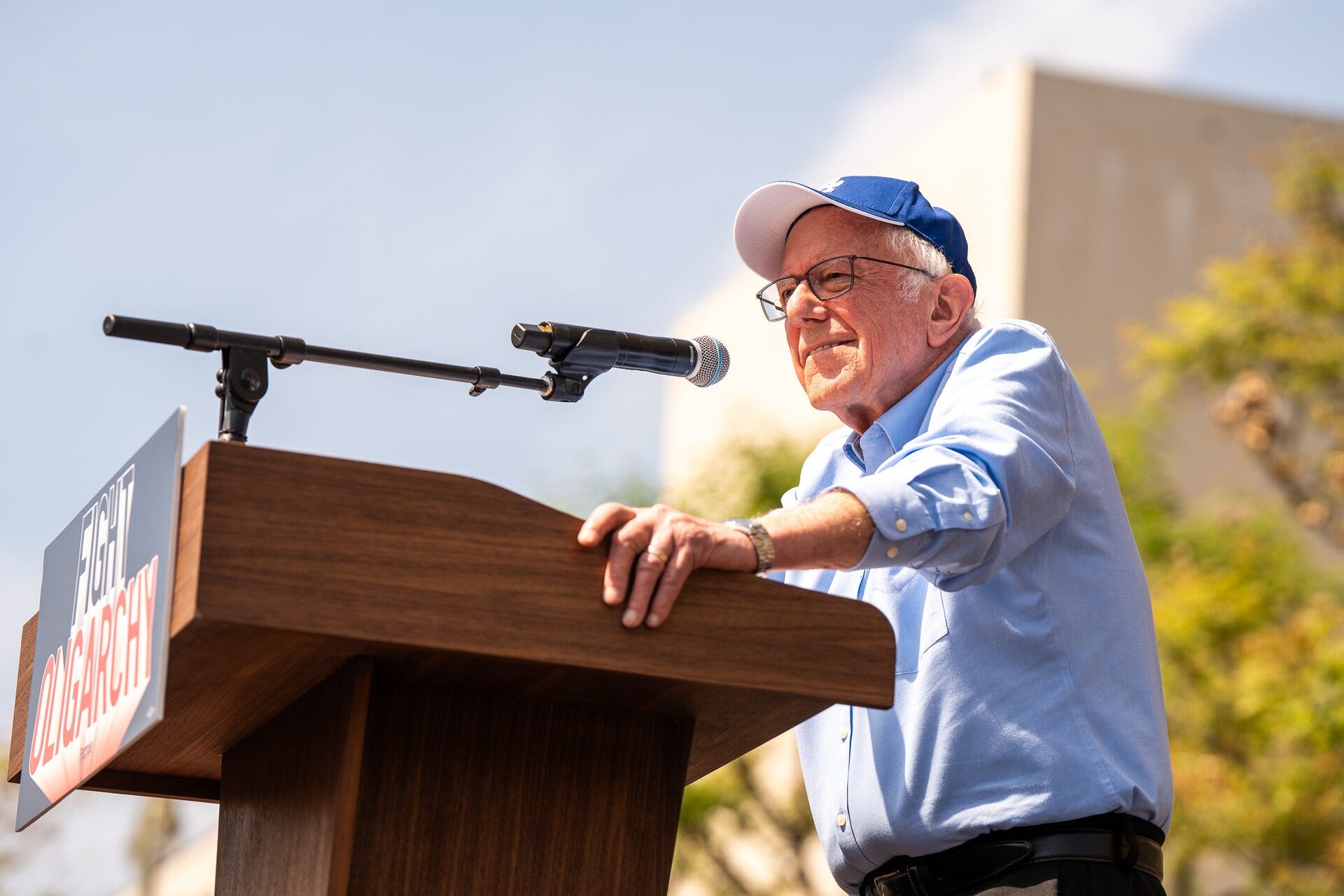
Not surprising for anyone who has watched California politics as a bellwether of federal trends, Prop 40 is drawing national attention and intervention from out-of-state politicians. Progressive stalwart Bernie Sanders, the independent socialist Senator from Vermont, has begun campaigning around the Golden State, making a push to tax the billionaire class. He’s campaigning with, among others, Rep. Ro Khanna, who represents part of Silicon Valley and is positioning himself for a 2028 run for president.
In a press event previewing his California tour, Sanders insisted that Prop 40 is of vital national importance. “It deals with the most important issue facing our country,” he said: “Can the American people take on the billionaire class, their incredible power, their greed, and their unlimited amounts of money, or are we destined to become an oligarchy, economically and politically controlled by a handful of the very wealthiest people in this country?”
He likened the threats by billionaires to leave the state to “extortion.” Asked by The Contrarian to elaborate, he said: “What they are doing is literally putting a gun to the heads of the people of California, and saying, ‘If you stand up to us, and you demand that we pay more in taxes so that your kids can have health care, we’re going to punish you.’ I think that is morally disgusting.”
Sanders acknowledged that some billionaires might make good on their threats to find a new home state. But he argued that this is a fight voters can’t afford to lose. “Is that the kind of society that we want to live in? Where billionaires can threaten working people if they vote in a certain way?” he asked. “Really? Does that have anything to do with democracy?”
Prop 40 is not the only big tax measure on ballots across the country this November. Below, we offer a brief survey of other revenue-related ballot initiatives you should know about:
California
Another tax measure in the Golden State — Prop 3 — would make permanent a set of targeted income taxes for top earners that fund education and health care. The taxes would otherwise expire in 2031.
Colorado
A constitutional amendment — Amendment 87 — would replace the state’s flat, 4.4 percent income tax with progressive tax brackets ranging from 3.7 percent for the lowest earners to 8.1 percent for income above $1 million. The increase in revenue would be targeted for child care, education, and healthcare funding
Missouri
A constitutional amendment — Amendment 7 — would create a “Show-Me Prosperity Investment Fund,” a state equivalent of a sovereign wealth fund that would invest state money in the stock market, with the pie-in-the-sky aim of growing the fund over time to replace state income taxes.
Utah
An anti-tax constitutional amendment — Amendment B — would establish a supermajority, 60 percent threshold to raise, expand, or adopt new taxes.
Washington
Initiative 645 seeks to repeal a 9.9 percent tax on incomes in excess of $1 million, scheduled to go into effect in 2029.
Tim Dickinson is the Senior political writer for The Contrarian


The Sixteenth Amendment ratified in 1913 allowed tax to be collected based on income and shifted taxes away from consumer tariffs, lowering the cost of everyday goods for everyone. It allowed a continual stream of money to be directed towards public projects and infrastructure and helped fund WWI. It was very much opposed by the robber barons of the gilded age, but was passed regardless. It is how our modern government was funded and I can't help but see the actions of Trumps and his cronies as a return to excluding any tax for the wealthy, while they exploit and plunder this country with unfettered greed. We are heading backwards in that respect and allowing the rich in this country to be excluded from paying their share of taxes will return us to a time where everyone struggled with everyday costs, while the wealthy lived their lives of excess and extravagance. The income disparity is rising daily, and most Americans are feeling the stress of all of this. We are living with oligarchy running this country, and are reaping the damage that occurs when this happens.
I am a bit torn on how to vote on Prop 40. I fully support a wealth tax on billionaires but it needs to be a National tax to remove the threat of moving to a different state. I will definitely vote no on propositions 41 and 42 as they are funded by the rich to try and block future decisions on increasing tax rates. I am leaning towards voting for prop 40.
I would be an ardent supporter of legislation to repeal prop 13, which gave massive tax breaks to homeowners. That was the proposition capped property tax rates, supposedly to help old ladies to sell their homes without paying increased property taxes on their new homes. Now people who support this idea want to extend it to their children so that there are two classes of home owner, one whose families are grandfathered in at perpetually lower property tax rates while the rest of the people pay the usual rates. Home values have skyrocketed. Sell your home and then pay property taxes like everyone else on new home or rent.
https://en.wikipedia.org/wiki/1978_California_Proposition_13