


If the 2026 midterms develop into a Blue Wave, Democrats not only have an opportunity to capture Congress, but to expand their capacity to govern in states across the nation. Democrats currently hold twenty four governors’ mansions, meaning a solid majority — important for symbolism as much as for blue-state solidarity — is within reach. (Fun fact: Democrats already govern nearly 50 million more Americans than Republicans by population.)
Why does electing Democratic governors matter? State chief executives offer a crucial line of defense as our democracy strains against the unstable authoritarian impulses of President Donald Trump. Governors can also move the needle on vital priorities from reproductive rights and election protection to data center regulation and healthcare access. Particularly in the South, winning governor seats is a prerequisite to unwinding the racist redistricting enabled by the Supreme Court’s execrable Callais decision.
In several states, Democrats also have a chance to bust up GOP trifectas — meaning states where one party holds the governorship and both chambers of the legislature — ending the MAGA stranglehold on state government. In other states, Democrats will have to play defense, lest their sitting governors get tossed out in the anti-incumbent fever of 2026.
Below, a look at seven gubernatorial races to watch closely:
Florida
The land where Donald Trump votes (by mail) has solidified its status as a Red State, and Republicans currently enjoy a trifecta. But after years of Gov. Ron “Rubber Boots” DeSantis governing from the front lines of the culture wars, the Sunshine state may be ripe for change.
David Jolly, the former GOP representative and polished cable-TV talker, is running as the Democratic nominee. Jolly can talk the talk of old-school, George H.W. Bush conservatives, while not alienating core Democrats. Watch Jolly’s interview with The Contrarian.
The MAGA nominee is Byron Donalds, a House member whose true claim to fame is as a tireless hypeman for Trump. Donalds backed The Donald’s illegal war in Iran, posting: “Peace is achieved through strength, not weakness. I stand with President Trump.” Donalds was also a big fan of Trump’s trade war, praising Trump’s inflation-sparking “RECIPROCAL TARIFFS” in all caps.
But there’s evidence that chumminess with the chief executive is becoming a liability, even in the land of Mar-a-Lago. Donalds was just caught scrubbing mentions of Trump from his website. However, Trump’s “Compete and Total Endorsement” lives on: “I know Byron well… and he is a TOTAL WINNER!” Trump wrote. “As Governor, Byron will… work closely with me to advance our America First Agenda,” he added, insisting: “HE WILL NOT LET YOU DOWN!”
Other races of note: Jolly is running on the same statewide ballot as Senate candidate Angie Nixon. Her democratic socialist views are very different from those of Jolly, himself a full-throated capitalist. But Nixon could supercharge Florida’s Black and progressive voter turnout, to the benefit of the Democratic ticket.
Outlook: Likely R
Georgia
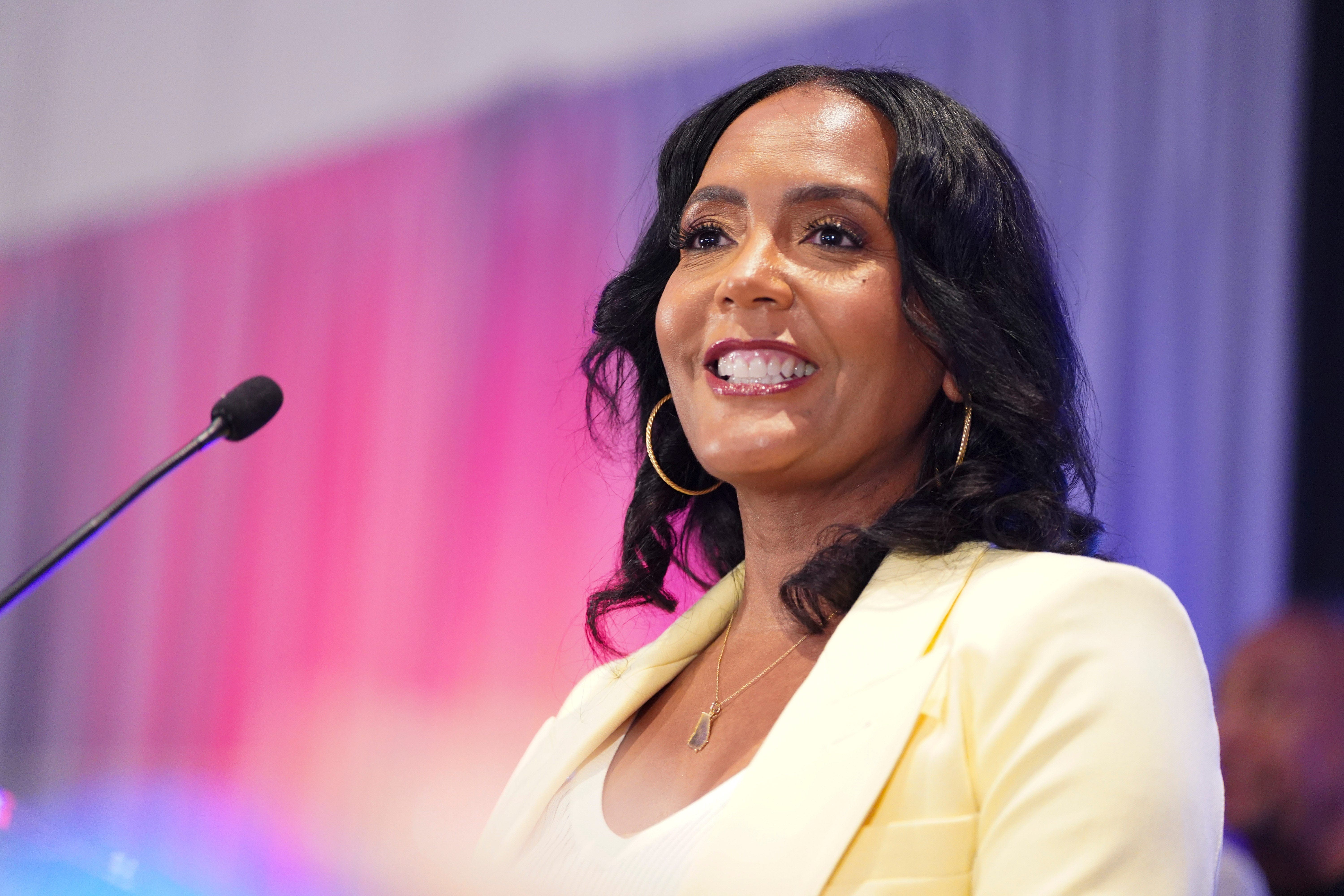
Former Atlanta mayor and senior Joe Biden advisor Keisha Lance Bottoms is the democratic nominee for governor of Georgia — another GOP trifecta state. Bottoms is campaigning on affordability with a platform that includes eliminating income tax for teachers, blocking corporations from buying up housing stock, and expanding Medicaid under the original provisions of Obamacare. (Watch Bottoms’ full Contrarian interview with April Ryan.)
The GOP nominee is billionaire healthcare CEO Rick Jackson, who is running as an “outsider,” despite having been a business partner of Jeb Bush and been endorsed by former Speaker Newt Gingrich. Jackson gave $1 million in 2025 to a Trump-backing SuperPAC, but did not earn the president’s primary endorsement. He won anyway, by pouring more than $80 million of his own money into the race. (Trump has since backed Jackson as a “true champion.”)
Jackson is also a film producer on the side, including of the Christian drama 90 Minutes in Heaven. (He has battled the IRS over tens of millions in tax deductions he’s claimed from losing money in the movies.) Billing himself as “Action Jackson,” the billionaire has a vague platform that includes calls for sweeping tax cuts and using “AI to eliminate wasteful spending.”
Other races of note: There’s a synergy on the statewide ballot with Sen. Jon Ossoff running for reelection and Bottoms running for governor on the same ticket, with each activating constituencies that could benefit the other.
Outlook: Toss up
Ohio
Dr. Amy Acton is a former Director of the Ohio Department of Health. The Democratic nominee became a statewide figure by helping to lead Ohio through the COVID pandemic alongside GOP governor Mike DeWine. (Ohio is also a trifecta state.) Acton’s affordability agenda includes passing a working-class tax cut and cracking down on wage theft. Watch Acton’s Contrarian interview with Jen Rubin, where she talked about normal people standing up to the the billionaire class:
The GOP nominee is Vivek Ramaswamy, a billionaire connected to Peter Thiel who briefly served as co-chair of DOGE with Elon Musk, before Musk had him booted. A former pharmaceutical executive, Ramaswamy ran for president in 2024 before ultimately backing Trump — who has returned the favor in this race, offering his “COMPLETE AND TOTAL ENDORSEMENT!“ to a candidate he called “something SPECIAL. He’s Young, Strong, and Smart!”
Other races of note: Populist former senator Sherrod Brown is also on the Democratic ballot, taking on appointed GOP incumbent Sen. Jon Husted. Brown and Acton are well aligned on message and vibes.
Outlook: Toss up
Wisconsin
Wisconsin has shown it’s possible to course-correct from MAGA-style, anti-democratic insanity. The state has put much of former GOP Gov. Scott Walker’s disastrous legacy in the rearview, thanks to two terms of mainstream Democrat Gov. Tony Evers. Keeping that momentum going is the task of Democratic nominee David Crowley, who has served as the executive of Milwaukee County.
Crowley is running on what he calls Badger Basics, focused on affordability, improving childcare and healthcare services, and expanding economic opportunity through education and small business development.
The Republican in the race is Rep. Tom Tiffany, who also has Trump’s “Complete and Total Endorsement.” The president praises him as an “America First Congressman” who “has always been at my side.” Tiffany has backed Trump’s trade war with Canada and voted repeatedly to enable the war in Iran. He also has billionaires in his corner, reportedly benefiting from nearly $9 million in campaign cash ponied up by the megadonor trio of Richard and Elizabeth Uihlein and Diane Hendricks.
Tiffany’s priorities are opaque (he promises to uphold “the common-sense values we share”), apart from fighting data centers, on which he sloganeers: “We are America’s Dairyland, not America’s Dataland.”
Outlook: Toss up
Texas
In the Lone Star State — home to another GOP trifecta — Gina Hinojosa is the Democrat challenging the incumbent GOP governor Greg Abbott, who is seeking a state-record fourth term in office.
Hinojosa hails from the Rio Grande Valley, a crucial swing area, where Latino voters predominate. She worked as a union and civil rights lawyer before turning to politics. Motivated by defending public education, she served first as a school board member and, for the last decade, as a member of the Texas House. Watch Hinojosa’s Contrarian interview where she discusses her decision to run for governor:
Like DeSantis in Florida, Abbott has turned Texas into an epicenter of the culture wars, embracing school vouchers and ceding ground to Christian Nationalist billionaires. He is also fiercely anti-immigrant — once stringing 100 miles of razor wire at the border — and willing to campaign for statewide office with the notorious MAGA bigot Bo French.
Other races of note: Similar to Bottoms and Ossoff, there’s synergy in the campaigns of Hinojosa and Senate candidate James Talarico. Both will need a big turnout in the Rio Grande Valley if they are to become the first Democrats elected statewide since 1994.
Outlook: Likely R
Nevada
Democrats have another chance to take out a GOP incumbent in Nevada — a top presidential swing state — and to create a trifecta of their own.
The challenger is Aaron Ford, the state’s attorney general and former senate majority leader. (Ford has also taught math as a public school teacher.) He’s running to be the “make-stuff-cost-less Governor,” with plans to expand affordable housing, crack down on the middlemen who drive up prescription drug prices, and force data centers to finance their own clean power.
The incumbent is Gov. Joe Lombardo, a Trumpy former Las Vegas area sheriff who is best known for a record-setting veto streak. Lombardo has struck down more than 160 bills that would have, for example, mandated paid family leave, curbed price fixing, expanded early voting, and implemented gun safety measures — including banning firearm ownership for those convicted of hate crimes.
Lombardo recently defended Trump for pampering his billionaire pals. “Those billionaire friends provide jobs,” Lombardo asserted. “Unless you take care of them, those jobs are absent.” Lombardo has also touted Trump’s endorsement, thanking the MAGA president for his “leadership!” and pledging to “advance our conservative agenda and keep Nevada red! 🇺🇸”
Outlook: Toss up
Oregon
Oregon is a surprisingly competitive contest, revealing that even a deep blue state is not immune from the anti-incumbent fervor of 2026. (Oregon is a Democratic trifecta state). Gov. Tina Kotek, who has been in state politics for two decades, including as the longest-serving Speaker of the House in Oregon history, finds herself in an uphill fight.
Kotek made history (along with Maura Healey of Massachusetts) in 2022 as the first out lesbian governors. Since Trump took office, she has largely side-stepped personal confrontations with the president. She did succeed, however, in defusing his effort to deploy National Guard troops to the streets of Portland. More pertinent to November, Kotek’s record on key issues like homelessness and education remains a work-in-progress: “We have more work to do,” she conceded recently, “on Oregon’s toughest challenges.”
In a rematch from 2022, the Republican nominee is Christine Drazan, a longtime state legislator who has a slight edge in recent polling. Drazan doesn’t carry herself like an extremist, but she governs like one. As the state’s house minority leader in 2020, she led a GOP walkout that denied Democrats a quorum needed to pass a popular cap-and-trade climate bill. She’s also a supporter of the Supreme Court Dobbs decision and says she would have vetoed Oregon’s expansive state law guaranteeing reproductive freedom.
Other races of note: Progressive champion Sen. Jeff Merkley is a shoo-in for reelection on the same ballot. It’s difficult to imagine a significant number of Merkley/Drazan split-ticket voters. However, a Pacific Green Party candidate, Brett Smith, could siphon leftist voters from Kotek.
Outlook: Lean D
Tim Dickinson is the Senior Political Writer for The Contrarian