


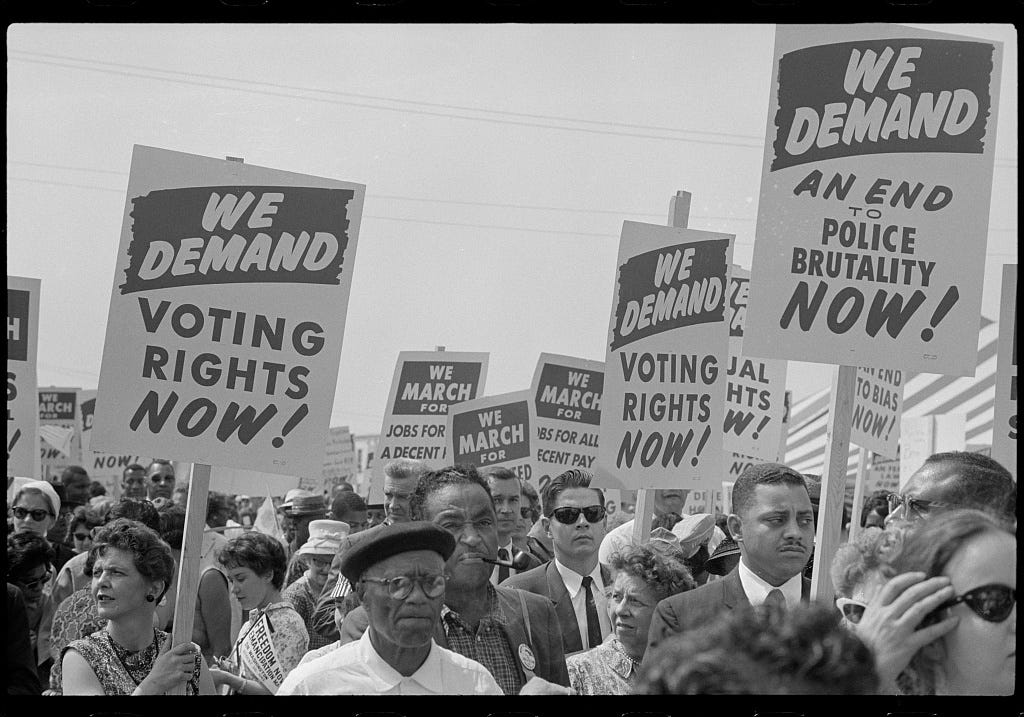
The Supreme Court’s Callais decision, gutting the Voting Rights Act, has given states in the South a green light to eviscerate Black and Brown voting power — under the pretext that doing so is simply partisan and meant to weaken Democrats, rather than to disenfranchise minority constituents.
In barely two weeks, majority-minority districts have been hacked out of existence in states from Tennessee to Florida, with more districts under immediate threat in Louisiana, Alabama, and South Carolina.
“There is a post-Callais stampede,” Contrarian publisher Norm Eisen described on a Coffee this week, adding that “the Roberts court is [working] hand in glove with these MAGA extremists across the South to wipe out the gains of the Civil Rights era and take us back to Jim Crow.”
In an interview with The Contrarian this week, Ari Berman sounded the same alarm. Berman is a top voting-rights journalist and author of Minority Rule: The Right-Wing Attack on the Will of the People. “This is exactly what happened in the Jim Crow era” in the South, he said. “There were no districts in which people of color could elect their preferred candidates.”
The racist redistricting rush is exposing as a cruel fiction the Supreme Court majority’s claim in Callais that “vast social change” has occurred, “particularly in the South” — which the court credited for making “great strides in ending entrenched racial discrimination.”
Here’s what you need to know about how the Supreme Court’s decision is eroding representation for minorities across the former Confederacy, and affecting the race for Congress for 2026 and beyond:
’26 Movers
Florida
The Sunshine State was the first to strike at minority voting power, post-Callais. At the behest of GOP Gov. Ron DeSantis, the state immediately adopted a new congressional map designed to net Republicans four House seats in the 2026 midterms.
This partisan gerrymander also nakedly eroded Latino electoral power. The new map took a hammer to a central Florida district that had sent the state’s first Puerto Rican representative to Congress. That majority-minority district has now been shattered, with voters divvied up across five whiter districts.
The new DeSantis map appears to violate the state constitution, which bars both partisan and racially invidious redistricting. This has set up a legal fight — supported in part by Contrairian subscribers — that may give state judges the last word on Florida’s maps.
Louisiana
Louisiana was at the center of the Callais lawsuit. Republicans there are aiming to eliminate at least one — and perhaps both — of the state’s majority-minority districts.
Under the direction of GOP Gov. Jeff Landry, the state has suspended its primary elections for 2026 House races, despite more than 40,000 voters having already cast early ballots. Landry wants a fresh start under maps more favorable to white Republicans, describing the move in Orwellian terms as “the best way to end race-based discrimination.”
The sudden suspension has created a “wild” scene of “widespread confusion” in the state, according to Berman: “The Supreme Court has said over and over, you shouldn’t change voting laws in the middle of the election. And then Louisiana just outright suspends an election.”
The ACLU and others are suing to restart the election under the existing maps, hoping to defend “the voices of voters who have already participated in the May primary election in good faith.”
Tennessee
The Volunteer State used a speed run in the state legislature to eliminate a Democratic district centered on Memphis, which has had its own representation in Congress since the 1920s.
The population of the majority-minority district was cracked into three new districts, which now each snake toward the center of the state.
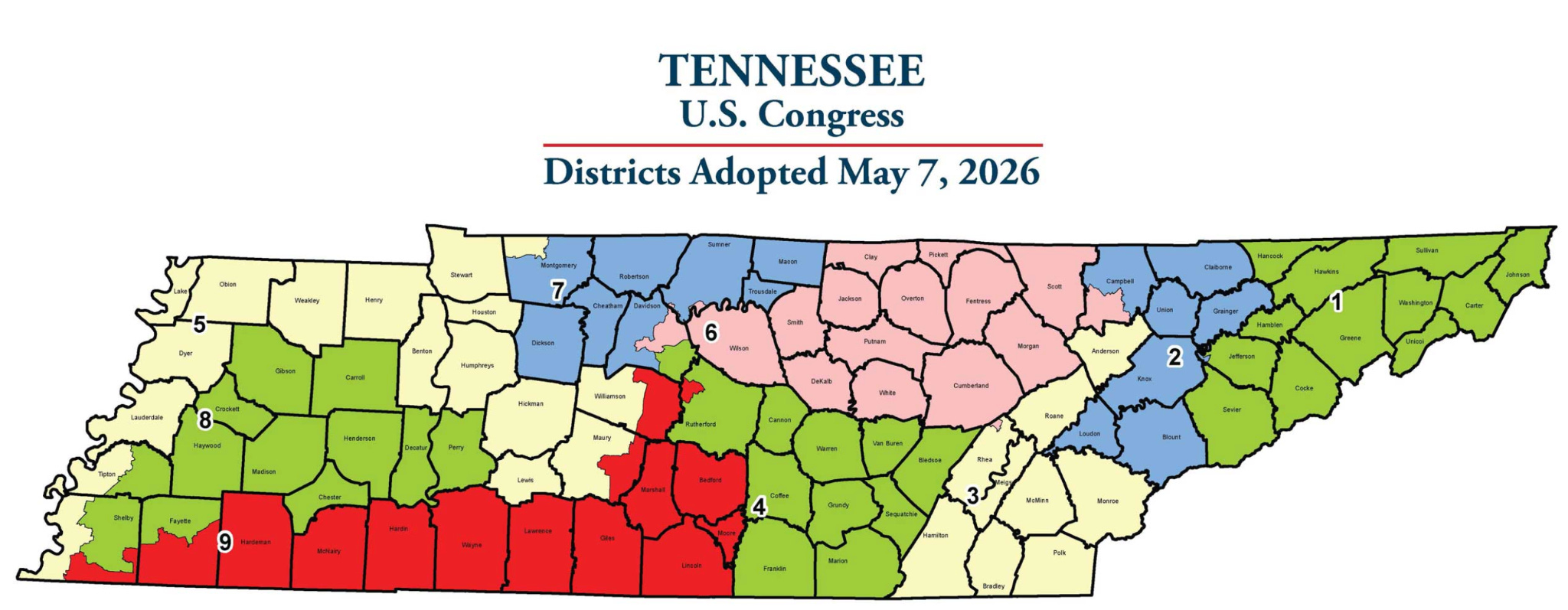
The contentious legislative session needed to pass the new maps featured a MAGA legislator striding into the chamber with a Trump flag draped across his back like a cape.
Driving home the voter-suppressing intent of the change, the same bill used to adopt the new maps also stripped a state requirement to alert voters to changed polling locations.
In the wake of the contentious session, Black Democratic state legislators who protested the change have also been stripped of committee assignments — ostensibly for “disrupting the democratic and legislative processes and creating disorder on the House Floor.”
The NAACP has sued to block implementation of the new maps, asserting that the mid-decade redistricting violates state law.
Alabama
To no one’s surprise, the “Heart of Dixie” wants to get in on the racist redistricting party. The state had previously adopted a map eliminating one of two minority-majority districts, only to have the Supreme Court block that redistricting in 2023.
But in the wake of SCOTUS’s reactionary Callais decision, that precedent is apparently shot; the High Court this week gave Alabama the go-ahead to redistrict under the previously unlawful maps. (The court did not, however, follow through on the Alabama Speaker’s unnerving idea to “overturn Amendment 14.”)
MAGA Gov. Kay Ivey celebrated the decision: “For years, we have fought for this outcome, and I am proud to celebrate this win for Alabamians.” Contorting state election law to enable the last-minute change, Alabama has passed a law invalidating House primary elections scheduled for May 19, and instead scheduled new elections for August.
Voting rights advocates with the NAACP, who had already cast early votes in the originally scheduled May contest, have brought a litigation seeking to keep the current maps in place, arguing that the new districts build on “intentional race discrimination in violation of the Fourteenth Amendment,” and that cancelling their ballots is unlawful. As Rep. Shomari Figures (D-AL) described in an interview this week with Jen Rubin: “To say, ‘Oh, anybody that votes in the current primary for certain congressional races, those votes won’t count’ — that, to me, is just beyond the pale.”
Virginia
In addition to the setback of Callais, the will of the electorate was dealt a blow in Virginia last week when that state’s supreme court threw out a set of voter-approved maps that favored Democrats.
Virginia had implemented an aggressive partisan gerrymander designed to pick up four Democratic seats in Congress. As was also the case in California, the new maps were put to a popular vote — and adopted by a wide margin.
But a 4-3 conservative majority on the state’s high court decided to discard the will of the voters based on a procedural technicality. To Berman, this court decision was an appalling strike against the principle of democratic self-rule: “Do you really invalidate an election retroactively — because of a minor procedural error? That, to me, is really, really alarming.”
South Carolina
MAGA Republicans in South Carolina are also jockeying to join the redistricting fight, and create a potential 7-0 House map for Republicans in Congress. This maneuver would divvy up a House district held by Democratic stalwart Rep. Jim Clyburn, who has served South Carolina for three decades.
The state initially looked like it might side-step a redistricting fight for the 2026 cycle — even in the face of ominous orders from President Trump on Truth Social to “GET IT DONE.” A handful of GOP state legislators bucked that demand. They blocked a motion to extend the state’s legislative session that required a two-thirds vote to pass, seeming to close the door to redistricting.
The state’s Republican governor, H.R. McMaster, however, has use executive powers to recall the legislature for a special session that would allow new maps to be adopted on a simple majority vote. The rush is now on to redistrict before the start of early voting May 26.
For his part, Clyburn has vowed to compete to win regardless, and cautioned that MAGA overreach could actually backfire by creating a dummymander that allows more Democrats to compete for additional seats.
Wait Until ’28
Georgia
In Georgia, GOP Gov. Brian Kemp has issued a proclamation calling for the legislature to meet in mid-June for a special session to take up redistricting in the wake of Callais. The move comes too late to impact the district maps for the 2026 election, where early voting is already underway, but would be in effect for House voting in 2028. The process is likely to oust at least one of the five Black Democrats now serving the state in Congress.
How to Fight Back
The MAGA assault on voting rights is spawning a rebirth of the Civil Rights movement. This weekend, on May 16, organizers of All Roads Lead to the South are leading a “Day of Action” and protest in Selma and Montgomery, Alabama, where The Contrarian will be on the ground covering the forward-looking action.
The only short-term answer to the right-wing assault on democracy is delivering MAGA forces a massive rebuke in the November elections. Make sure that you, your friends, and your family are registered to vote and have a plan to cast your ballots. (For more ideas on how to defend democracy, check out our “Contrarian Calls to Action” here and here.)
Tim Dickinson is the senior political writer for The Contrarian
If there is a god, I hope all those racist holy rollers will burn in hell for all eternity.
My comment earlier this morning also applies here: I never thought that the Supreme Court could ever be so disgusting. Please carry on Kagan, Brown and Sotomayor...you are true American Heroes.