


Genesis Moss Keefer always knew Sean Duffy, her co-star on The Real World, would eventually get into politics. In fact, she recalls that on their first day living together in a converted Boston firehouse back in 1997, he told his roommates he planned to run for president one day.
“His political rise was a surprise to nobody, at least not us. According to him, it’s the reason he went to law school and applied to be on the show in the first place,” says Keefer, who broke ground as one of the first out lesbians to appear on national TV in the ‘90s. (She filmed The Real World the same year Ellen DeGeneres came out.)
During their six months as roommates, Keefer, originally from Mississippi, did not exactly bond with Duffy, a competitive lumberjack from Wisconsin who embraced his role as the show’s token conservative. “To say Sean and I clashed is an understatement,” she says. “We came from two completely different worlds and never really understood each other.” Keefer was also put off by his “self-admittedly overly flirtatious behavior” with her.
Yet despite his right-leaning worldview, Duffy was not particularly homophobic. “I would actually say he tried his best to get to understand the LGBTQ+ side of things. He was definitely more open-minded back when he was in his 20s,” she says. In one episode, Duffy even accompanied Keefer to a gay bar — something it’s hard to imagine the staunch MAGA loyalist and anti-DEI crusader (who accused his predecessor Pete Buttigieg of being “so obsessed with pronouns” that he put the nation’s safety at risk) doing in 2026.
“He seems to have become radicalized over the years,” says Keefer, who now works as a travel advisor. Though she’s a lifelong Democrat who regularly attends protests and calls her representatives, Keefer has refrained from saying much about Duffy on social media since he was confirmed as Trump’s transportation secretary nearly two years ago.
That all changed on November 13, when flights nationwide were grounded for more than four hours because of a “communications breakdown.” The ground stop left thousands of people stranded at airports less than two weeks before Thanksgiving, adding stress and uncertainty to the holiday travel season.
Rather than apologizing and accepting responsibility for the resulting chaos, Duffy went on live TV, blamed everyone but himself for the disruption, and gave Congress a ridiculous ultimatum: fork over an additional $50 billion in funding to upgrade the nation’s aging air traffic control system, or else.
It was a spectacle straight out of the reality TV playbook.
Concerned about aviation safety and disgusted by what she sees as Duffy’s ethically compromised behavior in office — including making a family reality show that was funded by the companies he’s supposed to be regulating — Keefer decided it was time to, well, stop being polite and start getting real. She created a Change.org petition calling for Duffy to be replaced as transportation secretary, and posted it to her Instagram account.
“If this past midterm election showed us anything, it is that the American electorate is sick and tired of career, corporate-owned politicians,” she says of her decision to speak out. “Sean doesn’t seem to be indicating to us that he is anything otherwise.”
Many of Duffy’s other reality TV co-stars have followed suit, sharing critical posts on social media, including Danny Roberts, who filmed The Real World/Road Rules Challenge: Battle of the Seasons, with the future congressman in 2001.
In late September of that year, Hurricane Juliette struck Cabo San Lucas, Mexico, where Duffy, Roberts, and 30 other MTV reality veterans were filming the Survivor-like competition series. Production was shut down for a week as the Category 4 storm blew through the region, resulting in widespread destruction. (“They were filming there in hurricane season because it was a cheap rate,” Roberts wryly notes.)
The situation was dire, yet it also gave the contestants — who had no power and little running water — time to bond with the cameras off. It was “the one and only time where I feel like I really got to see behind the curtain with this entire franchise,” recalls Danny Roberts. “Everyone just let their guard down and shared so much about themselves.”
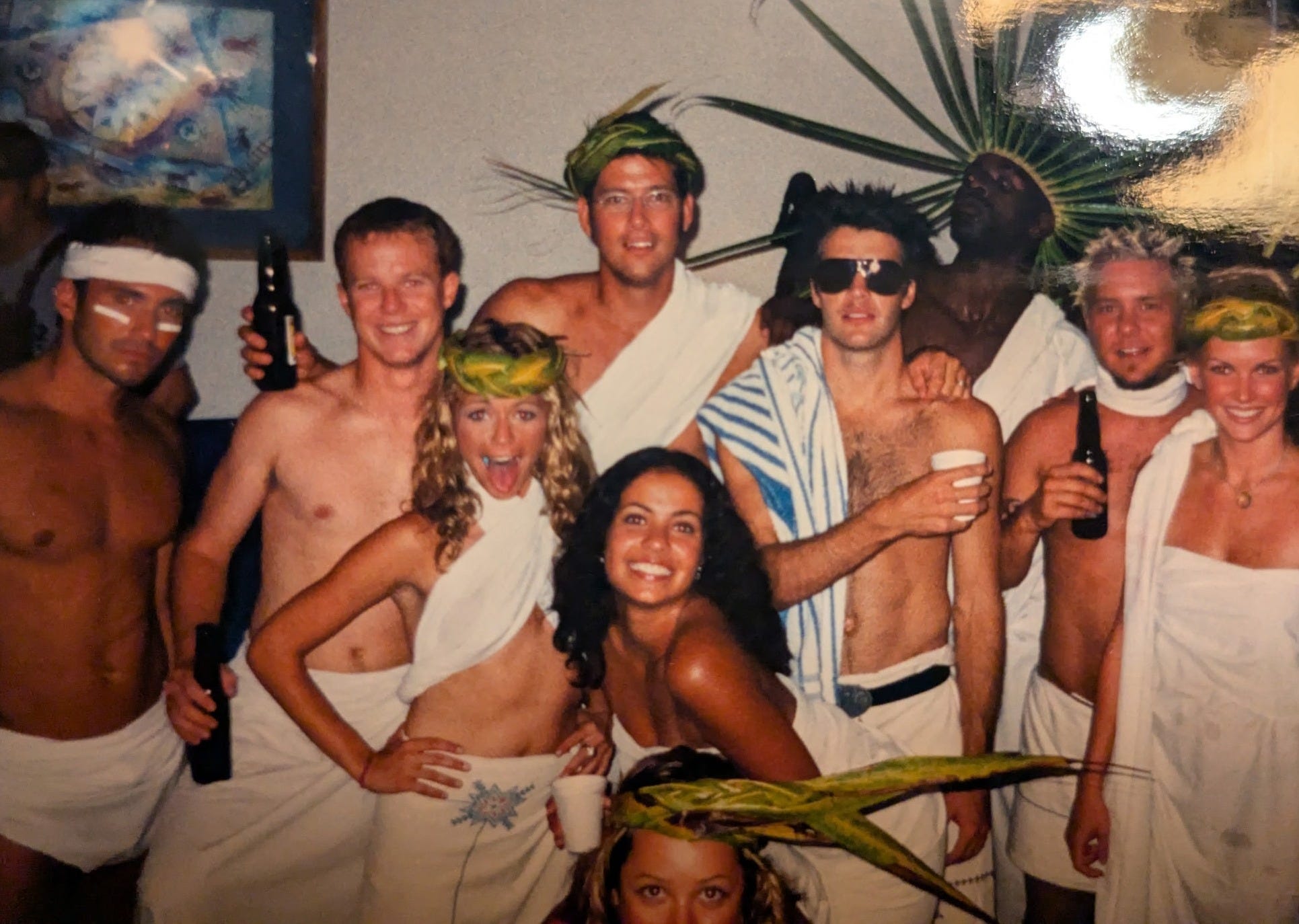
There were long talks and plenty of revelry, including a toga party, in which Duffy eagerly participated. At the time, he was already married to Rachel Campos, who appeared on the landmark season of The Real World set in San Francisco in 1994, and had a toddler at home. (The couple now has nine children.)
Roberts was in a very different place, personally speaking. A year earlier, he had become a fan favorite on The Real World: New Orleans. Millions of viewers were moved by his relationship with a closeted service member, whose face was obscured to protect his identity. The storyline showed the personal toll of the military’s “don’t ask don’t tell” policy, and was one of many examples of how The Real World once raised awareness of social issues like the AIDS crisis and abortion rights.
Roberts never got the sense that Duffy was wary of him because of sexuality. In fact, they competed on the same team — and ended up winning the grand prize. “He was just friendly, warm, easygoing,” Roberts says, noting that Duffy struck him as “an ex-frat business guy on a work trip,” not a conservative hardliner.
Less than a year after filming the show, Duffy was appointed district attorney of Ashland County, Wisconsin — the beginning of a political career that would take him to Congress, Fox Business, and eventually the Department of Transportation.
But in the quarter century that has passed since those debauched days on a storm-swept Mexican beach, Duffy has ascended the ranks of American politics by repeatedly aligning himself with the more extreme factions of his party. In 2010, he was elected to Congress, flipping what had been a Democratic seat for decades with help from the Tea Party movement and figures like Sarah Palin. The Duffys were early backers of Trump, speaking together at the 2016 Republican National Convention.
“Who says nothing good comes out of reality TV?” they said.
Roberts has been troubled by Duffy’s anti-LGBTQ+ rhetoric and voting record. As the father of a young girl, he struggles to understand Duffy’s steadfast loyalty to Trump, an adjudicated sex criminal with ties to Jeffrey Epstein. And as a Real World alum, he is saddened that the show’s legacy is now defined by Duffy and his wife, a Fox News host who serves no formal role in the administration but is an influential voice in MAGA politics. (She was mentioned by name in Vice President JD Vance’s notorious post analyzing the midterm election results).
Duffy’s incompetence and corruption have “brought shame to the entire franchise,” Roberts says. “That’s the only thing that people will likely ever remember now, which is such a shame.”
He contrasts the Duffys craven behavior with Pedro Zamora, the AIDS activist who starred with Rachel in the show’s San Francisco season. Zamora died a few hours after the finale episode aired on MTV, prompting a statement from President Bill Clinton.
The Duffys’ erasure of that legacy has been painful to witness, Roberts says, particularly given that Rachel was once close to Zamora and pays tribute to him on social media. The Republican power couple isn’t just degrading American politics, they’re also enabling “the destruction of a cultural institution,” he says.
Judd Winick, who was part of the San Francisco cast, feels similarly.
“I don’t know why Rachel and Sean do what they do. With all that is at their disposal, they could be doing a lot of good in the world, but they chose to go down this path,” he says. “They are a heartbreaking disappointment.”
Both Roberts and Keefer suspect that Duffy learned a lot about MAGA politics from the time he spent on reality TV.
“A show like The Real World is the most intense boot camp you could ever get for understanding the media,” Roberts says.
Trump and Duffy are both “media-centric figures who don’t know how to exist without being in the public eye, and have used reality TV to catapult themselves,” says Keefer, who was disappointed — if not surprised — that Bunim/Murray Productions, the company behind The Real World, produced Duffy’s reality series The Great American Road Trip.
“Bunim/Murray is no different than any other production company,” she says. “Their only priority is money.”
The last time she spoke to Duffy was in 2020, when he briefly joined a Zoom catch-up session with the Boston cast. He was at a rally in Wisconsin, and joked that it was “the only way to make us all come to a Republican rally with him,” recalls Keefer, who believes that her old roommate still harbors presidential aspirations.
“This has all been a build-up to what’s coming, if not in 2028, then possibly in 2032,” she says. “But mark my words, it is coming.”
Meredith Blake is the culture columnist for The Contrarian. Our team is consistently grateful for her words, wit, and wisdom.