


A pair of ICE shootings in the streets of Texas and Maine have refocused Americans on the wanton cruelty of the Trump administration’s immigrant roundups. At the same time, a new joint report by Human Rights Watch and the ACLU offers a harrowing look at abuses inside America’s largest immigrant detention facility, in El Paso, Texas.
Camp East Montana is a tent-wall facility hastily constructed at the Army base Fort Bliss — which happens to have also been the site of a Japanese internment camp during World War II. It has capacity to hold nearly 5,000 detainees, with the report describing it as “the largest immigration detention camp in the history of the United States.” It has earned comparisons to a concentration camp.
The joint report is titled: “‘You’re Only Getting Out Deported or Dead.’” The headline quote comes from an interview with a detainee at the facility, identified as Javier C. He recalled the orientation he received upon his arrival to the camp. “The guards told me, “‘When you get to El Paso, Texas, there’s no going back. You’re only getting out deported or dead.’”
The 84-page report is based on research conducted by Human Rights Watch (HRW) investigators from October 2025 through June of this year. The rights group interviewed 80 detainees either in-person or by phone or video call. The report also draws on court records, federal documents, and other official materials.
The topline findings are a gut punch:
Human Rights Watch and the ACLU found that people detained at Camp East Montana endured conditions of confinement that amounted to enforced disappearance; cruel, degrading and inhuman treatment; excessive use of force including one extrajudicial killing; life-threatening medical neglect; barriers to legal representation; and coercive third-country removals.
The rights groups concluded: “These abuses violate fundamental protections under U.S. and international human rights law.”
The Contrarian reached out to the Department of Homeland Security for its response to the report. A spokesperson responded with a lengthy statement of denial: “These claims that there are ‘inhumane’ conditions at Camp East Montana are categorically false. No detainees are being beaten or abused,” the statement says. DHS instead touts ICE’s detention standards, its provision of dietician “certified” food and “comprehensive” medical care, and highlights the agency’s avowed commitment to the “safety, security, and well-being of individuals in our custody.”
Yet this sunny assessment is undercut by ICE’s own inspection of Camp East Montana, which found dozens of “deficiencies” in detainee care and treatment — including a failure to segregate detainees with tuberculosis symptoms — as well as a recent nonpartisan report to Congress conducted by the Government Accountability Office. The GAO found that ICE had frequently failed in its oversight responsibilities and that substandard conditions at Camp East Montana were “risking the safety and security of detained noncitizens and staff.”
AN ‘EXTRAJUDICIAL KILLING’
The HRW/ACLU report sheds light on the infamous death of a fifty-five-year-old Cuban man, Geraldo Lunas Campos, in custody at Camp East Montana in January. An initial ICE statement on his death described the circumstances as benign. But a medical examiner later found the cause of death was asphyxia and ruled it a homicide. (ICE later changed its story and claimed Lunas Campos died after a “spontaneous use of force” intended to keep the man from “harming himself.”)
The HRW/ACLU report includes interviews with several men who observed or heard Lunas Campos’ final minutes. The witnesses recalled that the conflict started with the Cuban man insisting that he be provided his medication before returning to his cell in the camp’s solitary confinement unit.
A detainee identified as Aaron R. told the HRW investigators: “I heard Geraldo scream, “Me estás asfixiando” [“You’re suffocating me”] and “No puedo respirar, que Dios me bendiga” [“I cannot breathe, may God bless me.”]
Those were Geraldo’s last words: “I cannot breathe, may God bless me.”
Another detainee told investigators: “I heard Geraldo struggle and plead for his life. He did nothing wrong, he was just asking for his medication.” This man added: “I fear for my life at Camp East Montana. I know that what happened to Geraldo could have happened to me, it could have happened to any of us.”
The report is unvarnished in its assessment of the man’s death. “The case of Geraldo Lunas Campos constitutes the excessive use of force by officers acting on behalf of the U.S. government. The evidence strongly suggests,” it continues, that “this constitutes an extrajudicial killing under international law.”
ENFORCED DISAPPEARANCE
The horrors of Camp East Montana, the report describes, often begin before detainees even arrive. Far from comprising the “worst of the worst,” many of the detainees interviewed told investigators they had valid work permits and had been picked up near their place of employment or during routine traffic stops. Some described being yanked from vehicles and beaten or tased.
One seventy-two-year-old man, described as Alonso C, is a Cuban exile with work papers who has lived in the U.S. for more than four decades. He was picked up by masked ICE agents during a game of dominoes outside a Miami bodega.
As detainees like these were shuttled by ICE among various detention facilities, and ultimately shipped off to Camp East Montana, many of them dropped off the grid — with their families unable to locate them in any federal system. These practices, the report asserts, “amounted to enforced disappearance under international human rights law.” Enforced disappearance is a hallmark of repressive regimes — particularly Latin American dictatorships of the 1970s — and an egregious violation of human rights. “Because of its gravity,” the report states, “no circumstances may be invoked to justify or excuse its use.” But the report details that the Trump administration has made it commonplace:
In many cases during transfers from other detention facilities to Camp East Montana, detained people were held off the ICE locator system, denied access to legal counsel, and provided no means of contacting family members or attorneys using the facility’s tablets.
Detainees described “intense psychological distress after being detained and transferred without knowing where they were being taken or why,” the report states. Family members likewise “recounted extreme anguish as they searched ICE databases and repeatedly contacted Camp East Montana, only to be told that no information was available about their loved ones.”
The report emphasizes that when loved ones vanish at the hands of the government, family members “are themselves victims” of enforced disappearance — “a reality consistently recognized by international human rights bodies.”
‘ANIMALS ARE TREATED BETTER’
The report also illuminates the squalid living conditions that detainees are forced to endure at Camp East Montana. It suggests that ICE is violating the U.N. Standard Minimum Rules for the Treatment of Prisoners, also known as the Nelson Mandela Rules.
The report describes bunk units fouled by human waste, detainees suffering from insufficient food, and highly restricted access to the outdoors.
Camp East Montana holds detainees in pods, occupied by as many as 72 people. Inside a single large room, a pod includes rows of bunks, a dining space, and toilets and showers. “People eat in an open area directly in front of the bathrooms,” the report describes, “with no barriers separating them from the foul odors and frequent leaks that leave floors covered in water
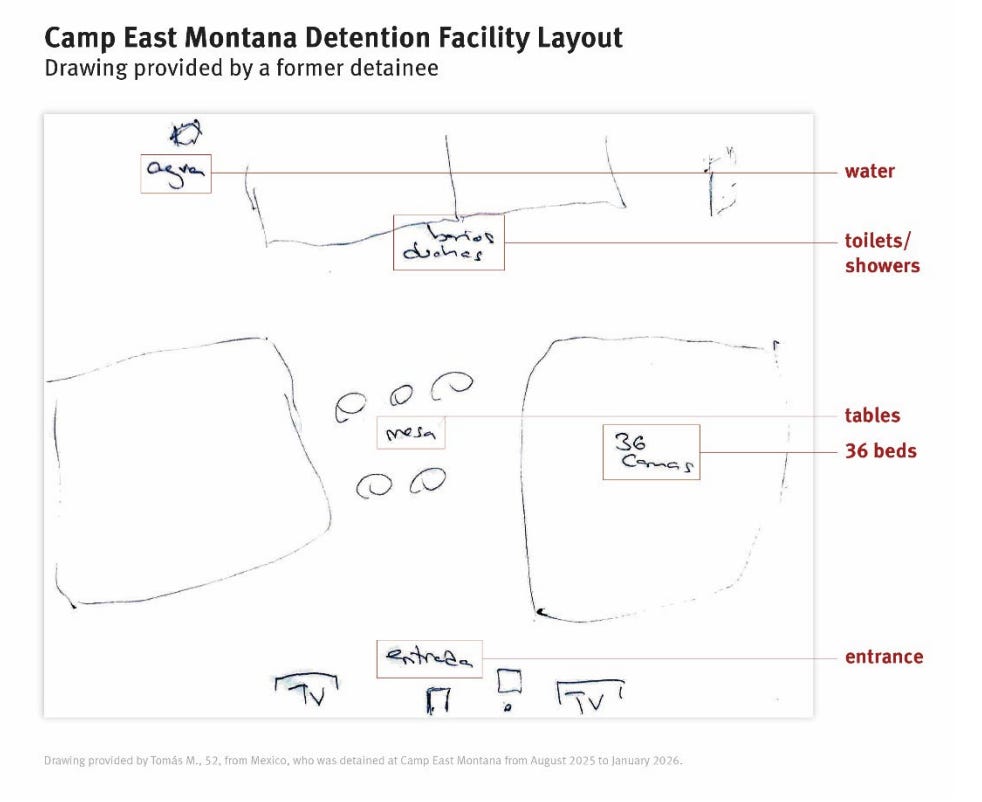
Pods are cleaned only once every two weeks, if at all. Inmates report begging for cleaning supplies to clean their own quarters, while living among constant “disgusting” smells of urine and excrement. These living spaces have no natural light or outdoor access; fluorescent lighting stays on from 6 a.m. to 11 p.m. Vents without filters blow in desert dust and bugs. The report finds other lapses in hygiene, including that “the government frequently failed to provide hand soap, hand sanitizer, and sometimes even toilet paper.”
The squalid conditions extend to the detainees’ clothing, as a man named Rafael H described:
We send our clothes off to be cleaned and they never return them. I have gone 15 days, forced to use the same underwear. Can you imagine how humiliating and unsanitary that is? They have also given me someone else’s dirty underwear back when I have sent my clothes off to be cleaned.
ICE standards call for five hours of outdoor time a week. But that benchmark is often flouted, the report says. A detainee named Lorenzo P told investigators: “I went a month without seeing the sun. The guards were just not taking us outside. The people in my unit were all becoming anxious and desperate with nothing to do. I felt trapped, it was torture.”
When outdoor access is granted, as many as 70 people are shuffled to an enclosed space with artificial turf, surrounded by barbed wire. Detainees described that they “could do little more than walk in circles.”
The nutrition at Camp East Montana is notoriously awful. As the report puts it: “People described the food as low quality, insufficient, and unhealthy. They told us the portions they received were so small that they were comparable to meals for toddlers.”
The report describes the camp routinely running out of meals for people with medically limited diets — who would then simply be denied food, or served moldy bread for complaining. “Detainees reported losing drastic amounts of weight, in some cases they estimated that they lost up to 30 pounds,” the report says, “due to insufficient portions and inadequate nutrition.”
Cost questions are not addressed in the HRW/ACLU report. But the GAO report to Congress makes plain that the camp’s insufficient meals are not the result of any resource constraint. Quite the opposite. The GAO identified “millions of dollars” in wasteful federal spending — resulting from the fact that the contract for Camp East Montana requires the government to pay for “the full cost of meals and operational services for 5,000 people,” regardless of the actual day-to-day population at the camp. The camp has typically operated at less than half of capacity. (Per the latest ICE data, about 2,000 detainees are currently held at the camp.)
Rafael H, a veterinarian from Colombia, told investigators: “I know that animals are treated much better than how they treat us here. Our situation,” he said, “is repressive. If we get sick, no one listens or cares. We do not have enough food to sustain healthy bodies. We live in cramped, dirty spaces and we’ve often gone weeks without seeing the sun. We are intentionally disregarded, left to rot.”
‘LIFE-THREATENING MEDICAL NEGLECT’
The HRW/ACLU report describes “grave deficiencies” in medical care and “life-threatening medical neglect” at Camp East Montana. It details “protracted delays and outright failures in the provision of medical care and medication,” as well as “incomplete and inaccurate assessments by medical staff, and punitive responses to medical emergencies.”
The HRW/ACLU report describes the case of Martin G, a sixty-six-year-old from Cuba who is a cancer survivor and had previously had part of his lung removed:
Martin informed officers about his chronic medical conditions and specified the medication he needed to take. He stated that he needed to see a doctor immediately as it had been over a month since his last check-in. Guards told him they would put his name down on the list, but his request went unaddressed for months.
Martin told investigators: “I’m scared that I will die here.” He added: “It is humiliating to ask for help daily and be ignored. I can tell the guards don’t care, maybe they don’t think we are human. It’s like they want to see us suffer.”
The findings of the HRW/ACLU report align with problems also highlighted by the GAO — which found that “detained noncitizens with chronic conditions did not receive treatment and care in accordance with National Detention Standards.” GAO highlights, for example, that “none of the detained noncitizens with diabetes or HIV had treatment plans in place.”
‘ROUTINE BEATINGS’
Given the woeful conditions inside Camp East Montana, detainees sometimes try to stand up for their human dignity, which has left them vulnerable to “routine beatings” the report describes, by roving bands of masked “anti-disturbance” guards who use wanton violence against detainees.
“The beatings and psychological abuse described by the people we interviewed,” the report states, “suggest a practice of punitive violence carried out to humiliate, coerce, and silence detained people who advocate for their rights and daily necessities.”
A detainee named Ricardo, for example, described being beaten and fearing for his life after complaining about not having a meal for 20 hours. A thirty-two-year-old detainee named Armando G. from Venezuela described being attacked by guards and sent to isolation for attempting to organize a hunger strike over inadequate food.
Rafael H. described the response to an impromptu protest, demanding more time outside. “My peers and I began kicking the door out of desperation. We need to see the sun,” he said. “Masked guards in black gear ran toward us in a group of ten. They beat us and took some of us to the hole,” he said, describing the camp’s isolation unit.
Germán L. described the violence as routine: “The guards beat us. When one person speaks up for themselves, they take it out on all of us. It doesn’t matter if you haven’t done anything wrong. They beat you just for insisting on getting your rights, food, or medicine when you don’t get it.”
At least two men described having their testicles grabbed by officers during such beatings. One of the men described that attack as “very painful and humiliating. I felt like I was being sexually assaulted.”
There does not seem to be accountability for guards who injure or even kill detainees, as in the case of Geraldo Lunas Campos. As the report describes: “the four men who saw or heard his interaction with guards…told us that the guards they believe to be responsible for his death were still working and overseeing detainees in SHU” (the camp’s solitary unit).
‘CLANDESTINE EXPULSIONS’
As The Contrarian has previously reported, abominable conditions of confinement serve a strategic purpose for the Trump administration: They coerce detainees to surrender their rights to due process and to agree to be deported rather than endure more time in captivity.
Camp East Montana makes it difficult to pursue due process rights, as the facility has an inadequate law library and visitation facilities for lawyers, according to the report. A half dozen people interviewed said they missed court dates because the camp’s staff did not take them to their hearings on time, adding months of detention as they await rescheduling.
The HRW/ACLU report also indicates that something more nefarious is at play in El Paso — where ICE has effectuated “clandestine” removals by putting detainees on busses to the Mexican border and coercing them to, in essence, self-deport, outside of any court order or legal framework.
As the report describes the situation: “It appears that the U.S. government employed a combination of physical force, threats, and deceit to induce detained people to cross to Mexico as part of clandestine and coercive third-country expulsions.”
This practice appears to be targeted against detainees from places like Cuba, where the country of origin did not want to accept a detainee’s return. Ramiro G., a forty-five-year-old Cuban, told the story of being suddenly herded onto a bus, driven to the border, and told he needed to get off the bus, cross the street, and board another to be taken into Mexico.
Ramiro had not seen a judge and did not have a deportation order. When he refused to get off the bus, the guards allegedly told him his only alternative was to rot in a U.S. jail: “They said, ‘Your country won’t take you; leave now or we’ll lock you up for life.’”
Isaac, a forty-three-year-old from Cuba, gave investigators a similar account. Except that before being placed on a bus to the border, he said he was brutalized by having his head slammed into a wall and his testicles “crushed.” When his bus reached the border, Isaac was told he had to accept being dropped off in Mexico or “be sent to a jail cell in El Salvador or to Africa.” (He refused to get off the bus, but saw many other detainees comply with the illicit scheme.)
The report cites this Trump administration practice as likely illegal: “The reported expulsions under threat and without deportation orders or due process,” it says, “in most cases would be in clear violation of U.S. law.”
‘SHUT IT DOWN’
The HRW/ACLU report offers more excruciating proof that the ICE detention regime is meant to punish detainees — the vast majority of whom have never been convicted of a crime, are accused of misdemeanor immigration offenses, and are simply awaiting a chance to plead their case in front of a judge. Many of them are refugees from the kinds of brutal regimes that Human Rights Watch has historically made infamous, people who came to America seeking asylum and a chance at a better life.
The conditions are so dire at Camp East Montana that some detainees have contemplated self-harm over continued detention. The investigators interviewed Ismael M., a twenty-eight-year-old from Central America, who’d been captured by ICE, separated from his family and held in limbo in Texas — waiting to be deported back to Honduras, which he’d fled in fear for his life: “I sometimes look at my bed sheets,” he said, “and I wonder if it would be easier to hang myself instead of trying to survive this torture.”
That America is tolerating this kind of government-sanctioned brutality is a stain on our national character — and reflects the ways in which sadists like Stephen Miller, Tom Homan, Markwayne Mullin, and Donald Trump are corrupting the American idea.
Take it from Angélica César, a human rights lawyer and fellow for Human Rights Watch and the ACLU, who introduced the report. “ICE’s Camp East Montana is a human rights disaster,” she said. “The U.S. government should shut it down [and] conduct independent investigations into all abuses and deaths in custody.”
Or listen to Lorenzo P, a forty-four-year-old from Ecuador: “This place is a graveyard of living people,” he told investigators. “Anything can happen to you here.”
Tim Dickinson is The Contrarian’s Senior Political Writer
How can we allow this to happen? It is our moral obligation to end this horrendous brutality initiated by the corrupt President of our United States and enforced by his personal Gestapo. Don't look away! Vote for the return of decency to our United States. Our grandparents, almost all of whom were immigrants, are weeping for what our country has become.
I didn't know whether to weep or vomit after reading this piece. I hope there will be some equivalent of the Nuremberg trials to bring the perpetrators-- from Trump on down to the lowliest guard-- to justice. But I'm not betting on it.