


Donald Trump’s intensified, malicious assault on the arts in his second term should have surprised no one. Like all authoritarians around the globe, he views the arts community as a pack of subversive dissidents, a danger to his grip on power and his command of the public psyche. Ever since they shed the golden handcuffs of royal arts patrons, visual and performing artists have found themselves at odds with despots.
The values and qualities that are foundational to the arts — creativity, inclusiveness, whimsy, irreverence, internationalism, etc. — are a threat to totalitarian bullies who seek absolute control, demand an echo chamber for their propaganda, target minority communities, vilify nonconformity, and celebrate militarism.
In the case of the Trump regime, the antagonism between state power and the arts is no doubt heightened by a boorish president who worships only money and himself. For decades, New York City (the arts capital of America) has held in disdain the crass Queens real estate baron whose taste runs from laughably garish to cheap/cheesy.
Since returning to office, Trump has followed a familiar pattern among autocrats. In seeking to destroy the independent arts community, he has attempted to defund PBS, the Institute of Museum and Library Services, the National Endowment for the Humanities, and the National Endowment for the Arts — not to mention higher education (which fosters and cultivates the arts). He has reduced the arts’ stature by substituting gross spectacle (e.g., mixed martial arts) at the White House for celebrations of American culture, while invading and attempting to take over art institutions like the John F. Kennedy Center for the Performing Arts.
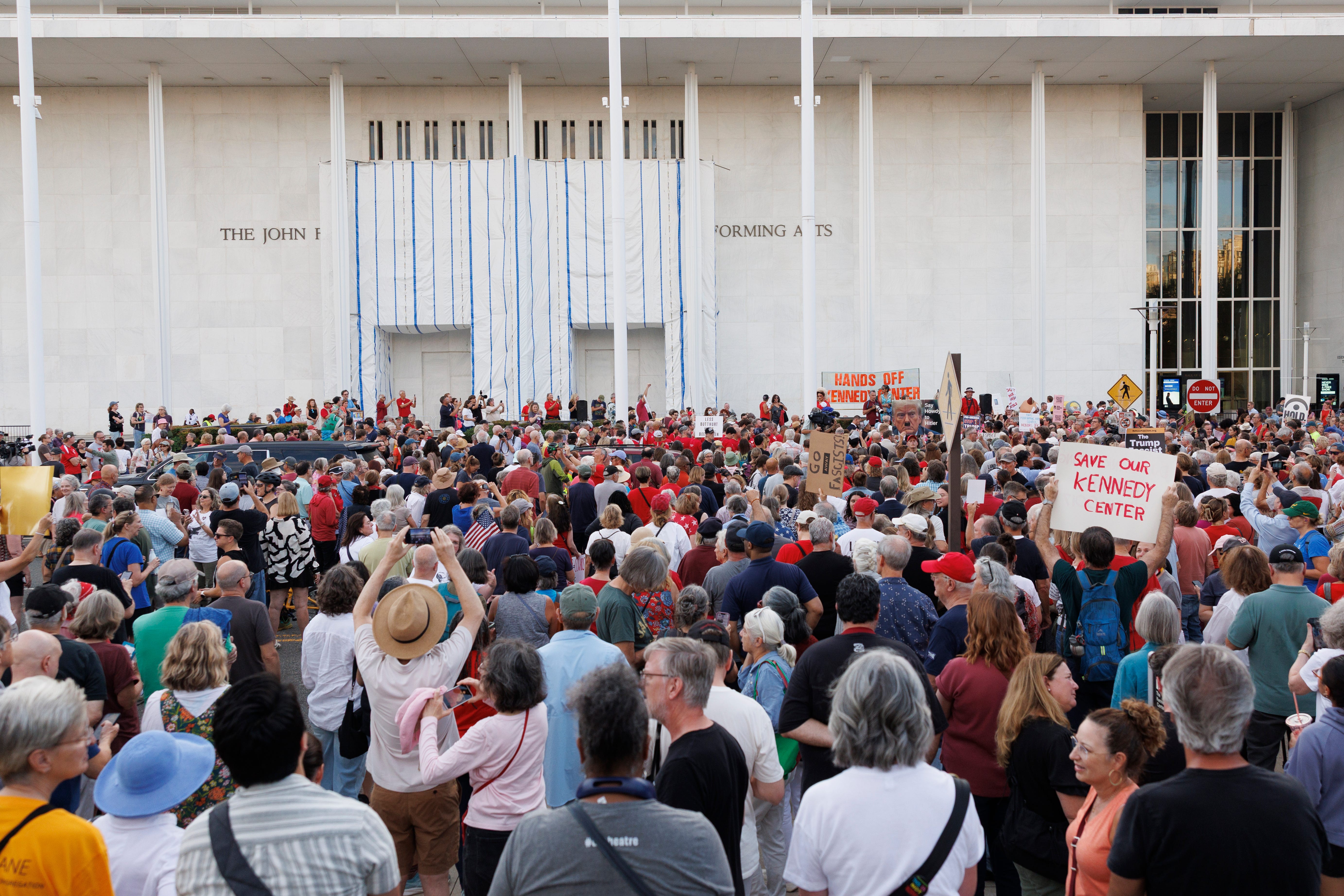
The only surprise in all of this was how thoroughly incompetent the barbarians were who pounded at the arts’ gates — and how visceral the consequent backlash has been. The takeover of the Kennedy Center has become one of the most visible, absurd displays of Trumpian ego and foolishness colliding with reality. In attempting to capture the Center, trying to MAGA-ize the programming, incessantly failing to affix his name to the memorial of a slain president, demanding it become another vanity architecture shrine to him, closing down the building to hide the flight of performers and audiences, and repeatedly incurring the wrath of judges and patrons, Trump has given his critics victories in court and plenty of incredulous laughs.
In response to the mad, boorish, wanna-be king, repeated, public displays of affection for the Kennedy Center have erupted. A massive crowd gathered to watch the letters of his name removed from the building. Again, the public metaphorically embraced the building earlier this month with a rally and march around the iconic structure. At these events and in the coverage surrounding the ongoing saga, Washingtonians have spoken lovingly of their own experiences at the Kennedy Center, their multi-generational encounters with the arts, and the arts philanthropy the Kennedy Center has contributed to the city in schools and through free performances. The Center is personal to thousands and thousands of people.
Now that the performing companies and outside artists have had to find other venues, the backlash has played out around D.C. I got a glimpse of this last weekend at a stunning performance of the Dance Theater of Harlem at the National Theater, which included the return of arguably its most iconic work, its 1982 adaptation of the Russian fairytale, Firebird.
Before the performance, executive director Robert Garland and representatives from the Washington Performing Arts Society spoke to the crowd. Given the origins of the company in the wake of Martin Luther King, Jr.’s assassination, its commitment to reaffirming the participation of African Americans in the classical arts, and the return of the dynamic prima ballerina Alexandra Hutchinson, who trained in D.C., one can imagine the emotion that animated the speakers and the crowd. What — in ordinary times — might have been perceived as banal references to city pride or the need to support the arts, the comments plainly had added punch, given our current climate. The speakers were repeatedly interrupted with applause and knowing laughter.
Attending the performance became not just a joyful expression of affection for a spectacular dance company, but a political statement reaffirming our civic commitment to the arts and our determination to defy the Orange Bully’s effort to commandeer them for his own purposes.
This sort of emotional encounter has not been a solitary event. The National Symphony Orchestra, homeless thanks to the deranged Kennedy Center landlord, has had to find other venues and construct a concert series on the fly. Its opening evening at the Strathmore Music Center in Bethesda was therefore highly anticipated.
The Washington Post described the scene:
The orchestra began the evening in the European fashion, entering as a group rather than milling about and tuning onstage while the audience settles in, which is more common in the United States. That created the occasion for a powerful expression of thanks and gratitude, as the players walked out en masse in white tie and long dresses.
An eager audience immediately stood to greet the now nomadic ensemble.
The Post report noted that in response to the Herculean effort of “securing a budget and scheduling a season outside the concert hall it has called home since 1971… their audience said thank you with a rousing display of emotion.” Such respect provides hope that “the NSO may not just survive the fiasco of Trump’s Kennedy Center takeover, but it also could connect to local audiences in a new way.” The report continued: “‘It will be an interesting season,’ music director Gianandrea Noseda said later in the evening. The audience laughed at the irony loaded into the word. And they laughed again when he stressed the bright side of the forthcoming peripatetic season: ‘It will be a bit more time to go here and there, but also more exciting: You can find different restaurants.’” And so it has been!
That spirit of joyous defiance now permeates the arts community in D.C. Under duress, it has found solidarity and newfound pride in a city that has long played (excuse the expression) second fiddle to New York.
Under siege from a fascist regime that failed to appreciate the tsunami of opposition it would unleash, the arts are enduring and flourishing. It takes more effort for arts patrons to reach the venues and navigate start-up online box offices, but — especially when done with purpose, as an act of resilience — that can make the experience all the more rewarding.
We celebrate the undaunted, undiminished, and unbowed artists, donors, executives, venue operators, staff personnel, and audiences who are ensuring that the arts thrive in D.C. More than ever, the country and the city need beauty, wonder, delight, camaraderie, and inspiration to remind us of our shared humanity and values.
We are grateful to all who keep arts alive — and look forward to the emotional high we will no doubt enjoy upon the release of the arts (and politics) from the fetid president’s grasp.
In the meantime, if you live or visit D.C., find a performance that speaks to you, and enjoy both the artistic experience and the opportunity to express defiance of the barbarian Trump regime.


Thank you for this wonderful piece. The arts must go on.
Thanks for such a fantastic Friday! I will be at an arts festival today and possibly tomorrow. Thanks for the music.🎵 🎻