


Donald Trump’s political toxicity, rampant illegality, and utter incompetence should not obscure a bigger worry: namely, that he is stone-cold nuts. Yet the legacy media continue to use language to describe his “speeches” as ordinary political addresses and “interviews” as within the realm of normal presidential interactions with the press.
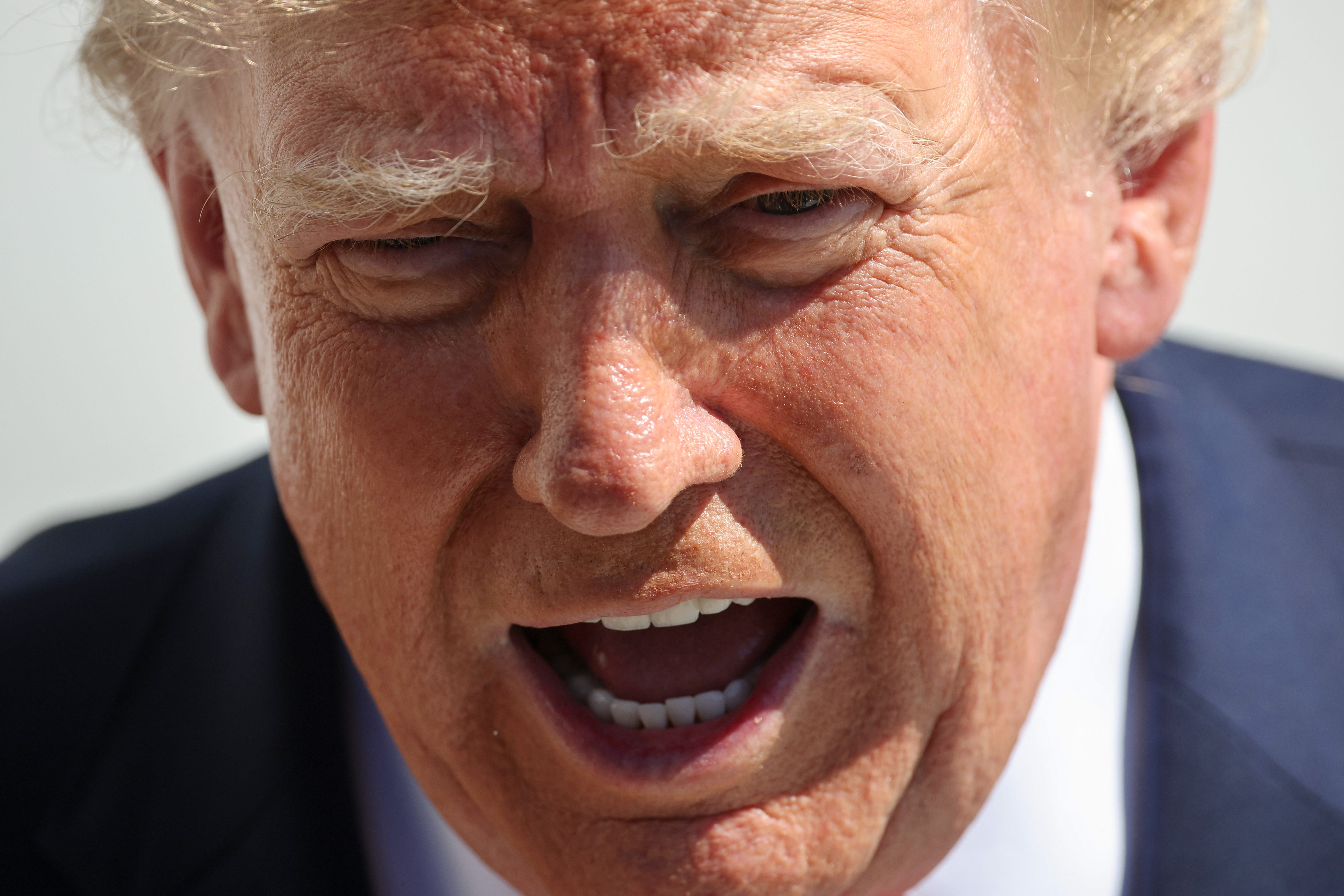
Legacy media’s sanewashing of Trump’s campaign appearances as “speeches” bears less and less resemblance to the reality of his verbal incontinence, evidenced in recent campaign blather about Iran:
We did it in one night with those beautiful B-2 bombers. They left Missouri. They flew both ways, 37 hours. They were refueling. We have the greatest tankers. We have the greatest military in the world. They went from Missouri and then at one o’clock in the morning, with no moon, dark as can be, these unbelievable machines led by the most incredible pilots in the world, they unloaded every single bomb, went right down air chutes into this, uh, drug factories, really. That’s what they were doing. They were nuclear and drugs. They were doing drugs, but they were doing the nuclear. These drug factories/nuclear factories were hit so hard.
When he unilaterally dragged us into a war, did he think we were attacking “drug factories” (or did he think the Iranians were “doing drugs”)? Examination of his unedited verbal vomit should provoke further, frightful questions about the 25th Amendment.
What we get from legacy media, instead, is the sort of New York Times’ light-hearted trip down nostalgia lane in lieu of exacting coverage of his crazed appearance in Mobile, Alabama on Friday. One had to search for independent media to uncover full accounts of his crazed rants.
Trump was more unhinged in Ohio on Saturday, where Trump blathered about James Talarico: “I see that ‘Tala-freako’ in Texas. So he’s been a vaygan' all his life. He’s a vaygan vaygan, I didn’t even know what the hell a vaygan was. A vaygan is vegetables. A vaygan is eating a piece of lettuce all day long.” Ignoring his apparent ignorance of the word ‘vegan,’ the nature of his obscene, irrelevant insults suggests a complete loss of impulse control. These are not “speeches,” but rather psychological breakdowns. But, unfortunately, you would not know it from mainstream media coverage. He was back at it in Nebraska on Monday with more unhinged rambling. (“With the war, it’s just artificial. It’s a little bit high. It’s a small price to pay ... let them take out Los Angeles, let them take out San Diego. This is a very small price to pay.”)
Similarly, Trump’s encounter last week with TIME was routinely labeled an “interview.” But an “interview” denotes responsive answers — not a stream of non sequiturs, insults, and outbursts. A few commentators ventured that the session was “grievance”-filled or “emotional,” but even those descriptions falsely suggest some orderly presentation of reality-based complaints in response to questions.
By lopping off his full replies and interweaving explanatory narrative, reporters often wind up sanitizing Trump’s babbling, as TIME did:
He said he regretted appointing Neil Gorsuch, Brett Kavanaugh, and Amy Coney Barrett to the Supreme Court, after they ruled against him on tariffs, mail ballots, and birthright citizenship. “I gave them the position of a lifetime,” he said, “and they voted against me often.” On his expectation of fealty, he was unapologetic: “I do like loyalty, yeah.” Again and again, he returned to the condition of the White House itself, complaining that his predecessors had left the building in disrepair and deriding Barack Obama as someone who “doesn’t know if something’s dirty or clean.”
They also posted the original, “lightly edited” transcript, which was exponentially crazier:
You said [Gorsuch, Kavanaugh, Coney Barrett] were like shells of their former selves. Do you regret nominating them?
Yeah. Yeah. What can I do? I put them in. They voted against me too often. I was very—I gave them the position of a lifetime, and they vote against me often. They vote for me too. The Democrats stick like glue—those three, they virtually never vary. You can come up with the worst thing in the world and they’ll vote as a group. And while I don’t like it, there’s something I admire about it: there’s loyalty. So they have loyalty to Barack Hussein Obama. They have loyalty to Biden, even though Biden doesn’t even know who the hell they are. He wouldn’t know. He doesn’t even know what the Supreme Court is. And me, I gave them the chance of a lifetime, and it’s unfortunate what they did.
Is that—
It’s unfortunate what they did—not to me, to our country. Birthright citizenship. It’s becoming a major industry now. People are making millions and millions of dollars, and we’re losing trillions of dollars. And it’s become a corrupt business, all because of the Supreme Court decision. That decision was for the babies of slaves. Look at where it was—look at where it was approved. It wasn’t for Chinese people, wealthy or unwealthy, coming, you know, pouring into our country. And this tariff decision again, all they had to do was a little clause saying any money paid does not have to be paid back…would have saved $400 billion. They chose not to save that.
You mentioned the word loyalty a moment ago. Is that what you want from your Supreme Court picks?
I do like loyalty, yeah.
Is that what you want from your Supreme Court justices?
No, I don’t want loyalty. I want good decisions. The tariff decision was disastrous for the country. I want good decisions for the country.
Sir, do you care about—
They’ve treated me. . . . Look, I put these people in. It is what it is. Very disappointing, very disappointing for the country—their decisions. And the country knows it. Very disappointing for the country. The other ones—they stick like glue. It’s unbelievable, right?
The Mob boss mentality, lack of logical connection between sentence fragments, self-contradictions, and elementary-school-level vocabulary in a froth of vicious anger reflect a deeply unwell mind — albeit notably less so absent in the sanitized version. Obsessive efforts to explain what Trump must mean are indicative of PR; not journalism. It takes a heavy hand and no small amount of spin, for example, to transform his rant on his disastrous war into: “In Trump’s telling, he is simply doing what has to be done, even when that means breaking foundational promises to his voters. He campaigned as a president of peace, but is now waging a war he says was necessary to prevent Iran from obtaining a nuclear weapon.”
Aaron Rupar, who assiduously records and posts Trump’s and his minions’ remarks arguably more thoroughly than any journalist, recommended (of the transcript) that we “read this to get a sense of the president’s grave cognitive impairment.” As he put it, “Trump is either unwilling or unable (or maybe both) to answer the questions he’s actually asked, so he just rants and raves while the interviewers do their best to provide structure to his random brain firings.”
As he ages, Trump’s decline will continue (maybe accelerate), meaning this is likely the “best” version of Trump we will see from here on out. Billionaire-owned media has essentially covered up that national crisis, refusing to acknowledge that he is deteriorating mentally and emotionally, just as he is physically (evidenced by bruising, swollen ankles, consistent somnolence).
Responsible coverage would highlight his mental unfitness daily, provide ample extracts of rants, and play them back to Republicans’ faces. Conscientious journalists, at the very least, could stop calling unhinged rants “speeches” and vitriolic outbursts “answers to interview questions.”


Did you see his attack on Tom Cotton for opposing year-round Daylight Saving Times? Trump argued that DST would give golfers and tennis players more late-day sunlight. Too bad for the kids going to school at 9 a.m. in the dark. Trump sees only what benefits him. Worst president ever.
Maybe the upside of the failure of legacy media to deliver on their duty to tell it like it is (aka print, post or broadcast the NEWS) could have a silver lining: as people drift away from those highly edited and prejudicial sources of information, they will either have to reform or go out of business.