


The contest for the Democrats’ Senate Majority Leader is much more than an inside-baseball personality contest. Ironically, establishment Democrats and legacy media outlets would sooner write it off as irrelevant and regard the re-election of Sen. Charles D. Schumer (D-NY) as inevitable. Both have invested time and effort in cultivating him and his staff; like a worn (or in this case, threadbare) sweater, they are loath to trade him in.
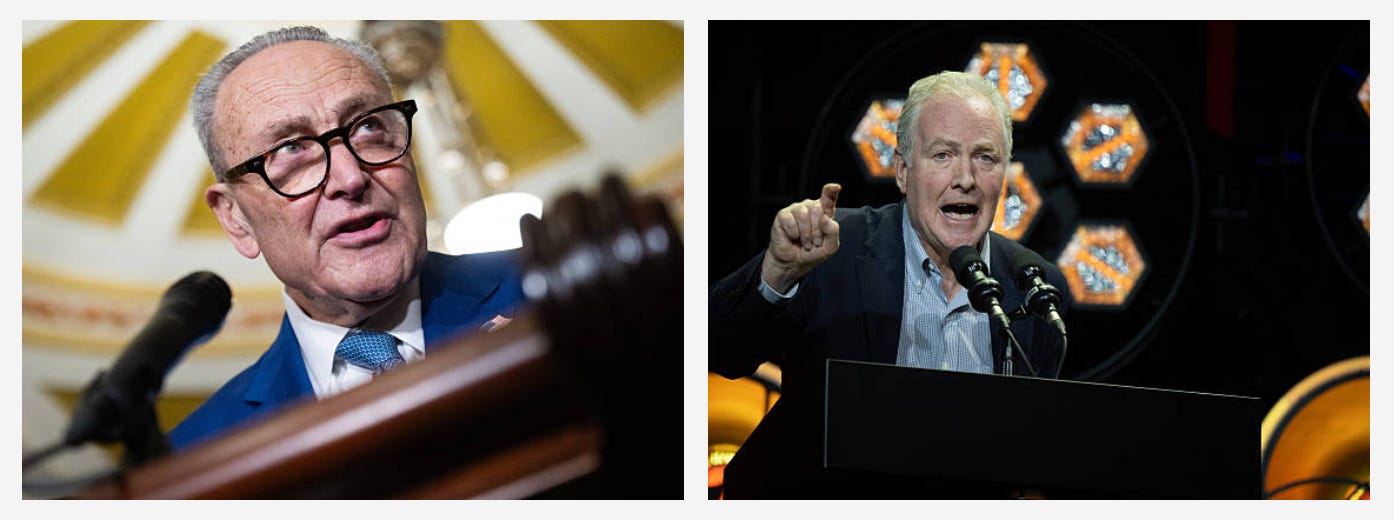
In exposing Schumer and establishment Democrats’ estrangement from the activist base (which is overwhelmingly backing Van Hollen), Sen. Chris Van Hollen (D-MD) has made the case that the job has importance far beyond the Senate cloakroom. His open, public-facing campaign for the job has vividly revealed Schumer’s greatest weakness: his inability to master the pace and vibe of our current political climate.
Schumer has tried in vain to move the vote up, trying to cut off the contest and stop the drip-drip-drip of support for Van Hollen. (The largest nurses’ union, the National Nurses United, endorsed the latter on Monday.) Despite his assuming the pose that his re-election is inevitable, Schumer’s vote count has stagnated. Public polling shows. However the vote turns out, it’s critical to understand the stakes.
Myth #1: “The leader’s personality does not matter.”
That’s a bizarre argument for any job in politics where “personnel is policy.” If the identity of the Senate majority leader were truly irrelevant, they could pick a name out of a hat, or rotate the leadership. But of course, senators don’t operate that way precisely because some are far more skilled than others at the job.
History tells us that some Senate majority leaders have been extraordinarily adept, keeping infamously independent senators (who, as the saying goes, all look in the mirror and see the next president of the United States) in line to achieve extraordinary goals.
The late Sen. Harry Reid (D-NV), cantankerous and prickly, pulled the Affordable Care Act over the line with no votes to spare, and — for better or worse — forced an end to the 60-vote rule for confirmations. It’s far from clear whether someone with a sunnier demeanor but looser grip on power could have achieved that.
And Democrats, of all people, would concede that Sen. Mitch McConnell’s utter decades of indifference to comity and his determination to change the composition of the Supreme Court changed not only the Court, but Americans’ constitutional rights (e.g., loss of abortion rights, evisceration of the Voting Rights Act) and the balance of power (inflating and distorting presidential power). Another leader with a modicum of conscience or respect for the give-and-take of democracy might have failed to do the generational damage that will be attributed to McConnell.
Myth #2: “It’s a backroom job.”
Certainly, part of the job is schmoozing senators and cajoling them for votes. But Schumer incorrectly appears to view that as the sum total of the job. He continues to run the campaign the way he handles the job, like an insider fueled by ego, bluster, and the unsubtle preference toward using carrots and sticks.
By contrast, Van Hollen, in putting out a compelling video and doing multiple interviews, reminds us that the job has changed — even since McConnell’s time. With the transparency/intimacy made possible by social media and a hyper-engaged, organized Democratic base, the Senate Leader is very much in the public eye. Schumer’s biggest problem may be how ill-suited he is to that aspect of the job. His feeble, cringeworthy public image impedes Democrats’ ability to paint the starkest contrast possible with a Republican Party dominated by Big Business, led by a mentally and physically decrepit figure utterly out of touch with the lives of ordinary people. Schumer’s lack of connection or appreciation for the base — which has frankly been aggravated by the way he is running his re-election campaign — renders any decision(s) he makes the subject of instant suspicion and second-guessing.
Moreover, especially for the party that does not hold the presidency, its congressional leaders become its personification. In the first year of Donald Trump’s second term, the aura of compromise, complacency, and capitulation defined the party and infuriated the base, helping spark movements like No Kings, as a direct reflection of the less-than-stellar leadership from the House and Senate.
When under the nose and with the consent of Schumer, weak-kneed senators cut a deal to end the shutdown over the Affordable Care Act subsidies, the ensuing backlash arguably contributed to the rise of fighters who went on to succeed in contentious primaries for the Senate (e.g., Peggy Flanagan in Minnesota, Abdul El-Sayed in Michigan) and House (e.g., Darializa Avila Chevalier in NY-13, Brad Lander in NY-10, or Will Lawrence in MI-7).
At the end of the process, Schumer may hang onto his job, but at the cost of further energizing the base determined to defeat him in 2028, should he seek reelection.
Myth #3: “This distracts from the fight over the agenda.”
In reality, the Senate leadership campaign has become the fight over the agenda. The choice of the Senate leader is the best proxy possible for the direction of the Senate, and for its list of top priorities.
Van Hollen is willing to shut down the government over the Iran War. We’ve heard no such promise from Schumer. No one seriously believes that Schumer would do the heavy lifting to knock a hole in (let alone eliminate) the filibuster, forcing Trump and Republicans to go on record blocking a series of high-profile, popular measures.
If Democrats want an agenda that is as aggressive as possible, which sets Democrats on a path for bold reform, creates a pathway for a Democratic president to take office in 2029, and has the maximum chance to force real fissures in a MAGA Republican Party on the verge of cracking up, then Van Hollen is the clear choice. Conversely, if Democrats think laying low, letting Trump and Republicans implode on their own, and leaving all options open for the future is the way to go, then keeping the status quo with Schumer is the best choice.
Myth #4: “You should rehire the manager of the World Series winner.”
How many times have you heard some version of that cliché? The problem is two-fold. Frankly, the Democratic “manager” made grievous errors. Big Democratic wins with impressive candidates were achieved by defeating terrible Schumer picks (e.g., Haley Stevens in Michigan or Janet Mills in Maine). And second, Schumer’s role has been grossly exaggerated. James Talarico did not need to be recruited. Schumer might like to take credit for Mississippi Senator-elect Scott Colom (who pushed back on the jaw-dropping chutzpah inherent in claiming credit for his meteoric rise), but Black stalwarts such as Rep. James Clyburn (D-DC), as well as the likes of Sen. Sheldon Whitehouse (D-RI), were on the scene much earlier.
Finally, the notion that Schumer — not the candidates themselves, not the grassroots movement, not MAGA self-immolation — is responsible for the historic midterm sweep personifies the egocentric, Beltway myopia that has bedeviled the party for years.


The Democrats leadership needs to read the room. The voters have spoken and they want new leadership
Yet another reason to replace Schumer is his support for fast tracking BAAJA.
There's a reason a majority of Democratic Senators, the ACLU, virtually every national environmental group, anti-ICE groups, the NAACP, tribal groups and so many others are firmly against BAAJA: it is a wish list for AI data center proliferation.
BAAJA will implement the polar opposite of what voters across the country clearly voted for regarding data centers. It is wholeheartedly backed by big tech and big oil. This bill will effectively nullify the Endangered Species Act.
It also explains why Charles Schumer joined nearly all Republicans (along with 20 other Democrats) is supporting the fast tracking of this awful bill ...knowing it will never get past the incoming Democratic Congress...just one more reason to replace Schumer as Senate Dem leader.
From the AI Now Institute:
'BAAJA functions as a “backdoor bailout”: enacting legal changes that will speed up and expand access to the industry’s biggest constraint—power—despite unacceptable costs to our economy, democracy, and environment. BAAJA helps AI companies double down on their speculative bets.
BAAJA also insulates an already unaccountable AI industry from pushback, serving hyperscale data center developers at the expense of local, state, and Tribal authorities. At a moment in which communities across the country and of diverse ideological leanings are scrutinizing the impacts of data centers on their economic and environmental futures, BAAJA would strip them of key tools that empower them to slow or reject the construction of data centers in their communities.....
Seventeen state attorneys general have raised urgent concerns that BAAJA undermines local, state, and Tribal authorities, despite recent amendments. The bill preempts local, state, and Tribal decision making over data center projects by weakening their authority to protect natural and cultural resources under the Clean Water Act, the National Historic Preservation Act, the National Environmental Policy Act, and the Endangered Species Act.'