


The horrors of Donald Trump’s ICE operations had largely faded from the front pages. ICE pulled back from in-your-face, militarized raids in cities like Minneapolis. And cartoonish supervillains like Homeland Security Secretary Kristi Noem and Border Patrol commander Greg Bovino departed from the federal government.
But for those detained in ICE facilities, little has changed. The Contrarian previously reported on the abysmal conditions of ICE detention and the parallels between these facilities and concentration camps. In fact, under the new leadership of DHS Secretary Markwayne Mullin, the cruelty continues.
The Delaney Hall ICE detention facility in Newark, New Jersey, run by the notorious private jailer GEO Group, has become a renewed flashpoint. Detainees inside the facility have mounted a hunger strike to protest “terrible and inhumane” conditions. An open letter from those inside describes concerns: wormy or rotten food, foul bathrooms, poor ventilation, widespread illness, inadequate medical care (“They only prescribe Tylenol for all ailments,” the open letter notes), and attempts by ICE agents to “coerce detainees into signing deportation orders.” Detainees also allege they are being forced to work, either without pay or for a pittance of $1 an hour.
GEO Group did not respond to questions from The Contrarian. DHS responded with a bizarre statement asserting “there is no hunger strike at Delaney Hall” and touting the facility’s “comprehensive medical care.” DHS spokesperson Lauren Bis added: “No lawbreakers in the history of human civilization have been better treated than illegal aliens. They are provided 3 meals a day, medical care, and receive full due process.”
Read other open letters from detainees about the appalling conditions at Delaney here and here. The detainee hunger strike at Delaney is part of a larger pattern of hunger strikes at GEO Group facilities from Pennsylvania to Michigan to California.
Instead of improving conditions inside, DHS has chosen violence outside Delaney — cracking down on protesters who have gathered in solidarity with the hunger strikers, hitting them with chemical munitions and intimidating them with armored vehicles. Last week, Sen. Andy Kim (D-NJ) took a blast of pepperball spray to the face while trying to keep constituents safe. “I tried my best to bring down the temperature,” he said in a video post on X, in which he decried the “normalization of violence in America.”
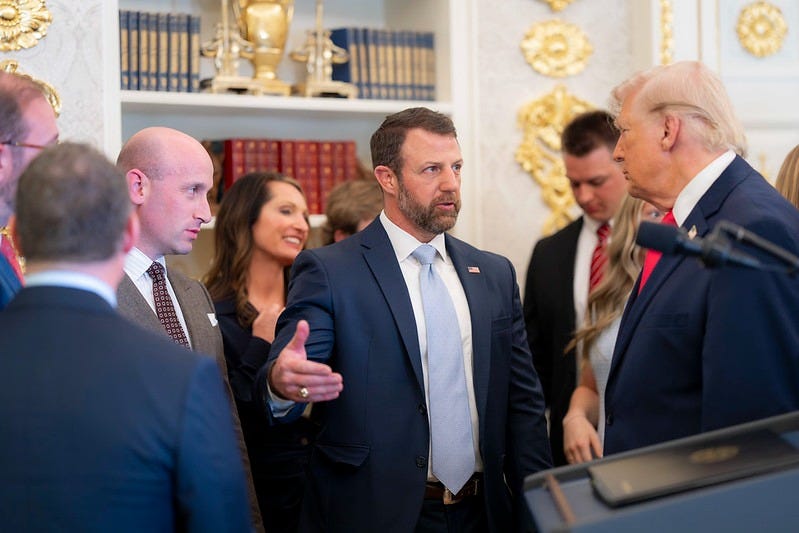
During a cabinet meeting with president Trump, Mullin made no apology for his agency hitting a former Senate colleague in a chemical blast, saying that Kim “probably shouldn’t have been there.” As for conditions at Delaney, Mullin made light of the hunger strikers’ demands, insisting “this isn’t a Holiday Inn” and adding that those complaining about food “can go back to their country.”
Kim has called out GEO Group for “profiting off of human misery,” insisting the publicly traded company is putting its balance sheet above human dignity. GEO Group recently reported a $100 million increase in quarterly revenue, and a 96 percent increase in profit, compared to the first quarter of 2025. “They can afford to hire more doctors,” Kim said. “They could afford to have better quality food that isn’t rotten and disgusting — but that’s less profit for GEO Group.” The New Jersey senator is calling for Delaney Hall to be shut down.
Over this past weekend, violence escalated at Delaney. Troublingly, New Jersey state troopers in riot gear took over the defense of the detention facility — squaring off against protesters and dispersing them with tear gas. These troopers are under the control of Gov. Mikie Sherrill, a Democrat, who incongruously has also embraced the protesters’ call for Delaney to be shut down.
For his part, former Border Patrol commander Bovino is now off traipsing the world, palling around with far-right figures in Europe and talking up “remigration” — or the forced expulsion of minorities. On X, he sent the staff of Delaney a stiff-arm salute. “You have the world watching,” he posted, “and supporting your efforts to hold the line.”
This isn’t, of course, the first time Delaney Hall has been in the news for poor detainee care — or for controversies with politicians. The ICE facility was one of the first flashpoints regarding detainee abuse in the second Trump term, and is where Rep. LaMonica McIver (D-NJ) was arrested and charged with “forcibly impeding” a federal officer — for contact that wouldn’t have been called a foul in the NBA. McIver, who is Black, was on the scene attempting to gain oversight access as a member of Congress. The Legal Defense Fund has called her prosecution a “brazen act of political retaliation and a worrying misuse of federal power.”
Echoes of Broadview
The administration is now, transparently, using lawfare to retaliate against those who would challenge or publicize its abuse of detainees. At a similar ICE holding facility outside of Chicago, known as Broadview, detainees have decried filthy cells, being deprived of adequate water and food, and even being filmed while on the toilet.
In late October, the administration charged six pro-immigrant protesters, including then-congressional candidate Kat Abughazaleh, on counts of intimidation and conspiracy for allegedly impeding the path of a federal officer’s car. Their arrests came at the height of the administration’s “Operation Midway Blitz,” in which Bovino and the Border Patrol wreaked havoc throughout Chicagoland.
But the case against the so-called “Broadview 6” unravelled dramatically in late May — amid alleged chicanery from the Department of Justice, which had allegedly warped the grand jury process. When one grand jury wouldn’t return the indictment the administration was seeking, reticent grand jurors were simply tossed off the jury, and the government had another try. The Assistant U.S. Attorney on the case also allegedly engaged in other prohibited behaviors with grand jurors. The judge overseeing the matter then received only heavily redacted grand jury transcripts from DOJ.
When Judge April Perry finally got access to the complete record, she declared herself “incredibly shocked” by redactions that had covered up prosecutorial improprieties. She said she could not grant the government the “presumption of regularity” that courts typically extend to the Justice Department: “That trust has been broken.”
In the same court transcript, Perry said that the case raised questions of a “vindictive prosecution” and that the behavior of government lawyers could merit “sanctions for prosecutorial misconduct” as well as “potential ethical violations, including lack of candor to the Court.” (The U.S. attorney at the center of the scandal has since been fired from a new job she’d taken with the Senate Judiciary Committee.)
Shuttering ‘Alligator Alcatraz’?
Beyond a judicial rebuke of unprofessional prosecutors, there is actual good news in the fight against inhumane detentions of immigrants. The notorious Florida state detention camp known as “Alligator Alcatraz” looks like it will be shut down, bringing to an end its ignominious run in the swampy Everglades.
Alligator Alcatraz was built at the site of a little-used airfield, in a mad rush by GOP Gov. Ron DeSantis, who — like Trump — sees cruel treatment of the undocumented as a boon to his political prospects. The camp has been a humanitarian disaster from the jump, marred by terrible sanitation and tent-walled cages that provide insufficient protection from the South Florida elements.
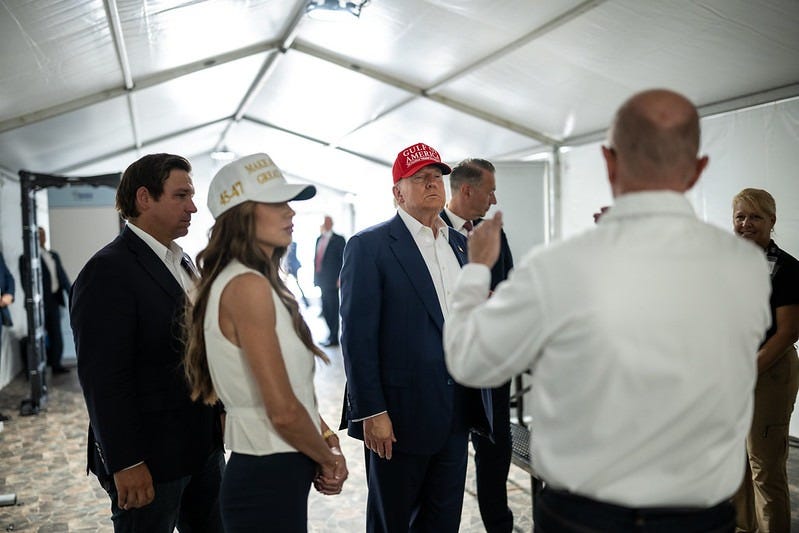
Initially, Trump touted the facility, touring it with his Homeland Security Secretary, Kristi Noem, as if it were the state of the art in migrant detention.
But an Amnesty International report soon described “inhuman and unsanitary conditions” at the camp that included “overflowing toilets with fecal matter seeping into where people are sleeping,” as well as “limited access to showers, exposure to insects… lights on 24 hours a day, poor quality food and water, and lack of privacy.”
Most disturbing, Amnesty described the use of a punishment that it states “amounts to torture,” called “the box.” It is described as a “2x2 foot cage-like structure people are put in,” shackled to the ground “sometimes for hours at a time, exposed to the elements with hardly any water.”
The facility has processed as many as 22,000 detainees. Hundreds of these were not tracked properly in federal databases and could not be located by reporters for the Miami Herald, raising dark questions about due process and disappearances.
The closure of the detention camp appears to have less to do with humanitarian concerns than ballooning costs and clashing assumptions of who would pay the bills. The state put up nearly half a billion for the construction and running of the facility — on the (flawed) assumption that the Trump administration was good for the money. That reimbursement has only just begun to trickle out.
Despite overseeing this wildly expensive, high-profile failure, DeSantis recently declared the inhumane institution a triumph: “If we shut the lights out tomorrow,” he said, “we will be able to say it served its purpose.”
The cruelty, after all, was the point.
Whether Broadview or Delaney Hall will join the ranks of future ICE detention center closures is a matter of sustained public outrage and attention. There are many horrors of the Trump administration that command our notice, of course. But few speak so directly to our national character. Human beings held in the name of our government require sleep, sustaining food, sanitary living conditions, and proper medical care. To tolerate less is a moral injury — and an abomination for which history will be our nation’s harshest judge.
(You can contact your members of Congress here.)
Tim Dickinson is the senior political reporter for The Contrarian
As it turns out, Mullin would not keep his promise to stay out of the news. He is worse than Kristi Noem. You can bet, this same scenario is playing out everywhere there’s a detention facility oops a concentration camp.
The purpose of ICE detention is to make life so miserable that people will agree to be deported rather than pursue their cases to stay in the US.
On a larger scale, private prisons are a terrible idea because the incentives are all wrong. The operators are paid by the prisoner-day: a fixed amount for every prisoner every day he/she is there. So the operator's profits increase the more prisoners it has and the longer it keeps them. So they lobby for more crimes and longer sentences; they make more profit by skimping on food quality and quantity, by minimizing medical staff and facilities, by paying guards poorly so they only hire people who can't get better paying jobs elsewhere, etc.