


The scale of Donald Trump’s and his family’s profiteering during his return to the presidency is vast. But the pushback so far has been ferocious — and it’s just getting started.
Let’s start with the increase in Trump’s personal fortune since returning to office. That and the related potential conflicts of interest involving him and his family are staggering. We lay all that out in our new Democracy Defenders Fund report, “The Family Legacy: Conflicts of Interest and Profiting from the Presidency.” In it, we document dozens of business ventures that the Trump family has launched, joined, or backed since the 2024 election, dramatically increasing their collective familial wealth by billions.
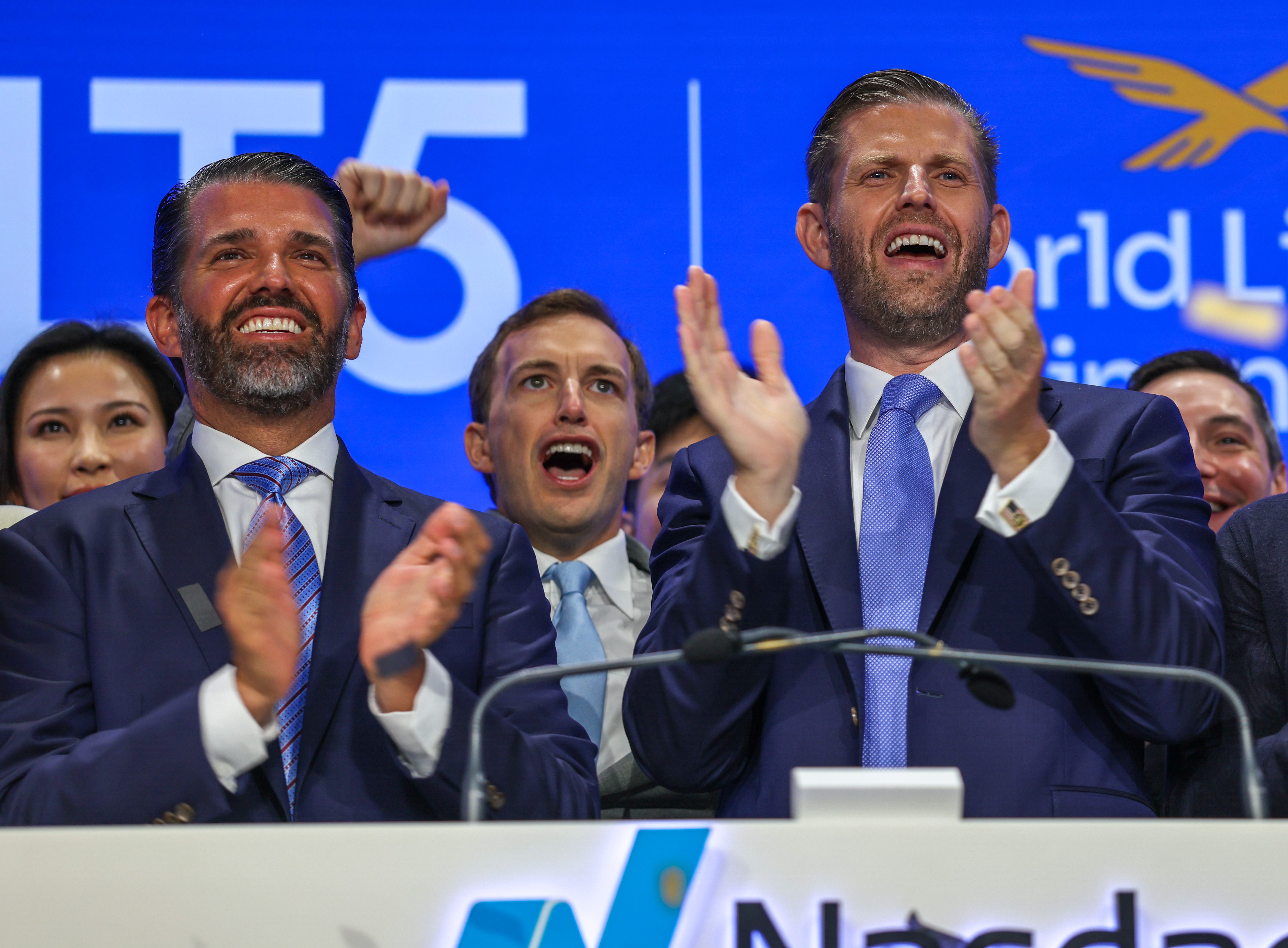
It’s no wonder that, according to polling, 90 percent of voters identified government corruption as a major or crucial factor in their voting decisions. In 2025, Trump’s reported income exceeded $2 billion, including $1.4 billion from his cryptocurrency ventures. All told, the president and his family earned approximately $4 billion last year. At the same time, about 1 million investors reportedly lost approximately $4 billion on Trump’s meme coin alone.
It doesn’t stop there. Many of the businesses to which Trump family members have attached themselves benefit from hefty government contracts, favorable regulatory conditions, and foreign investments. As Trump put it, “Almost anything they do, if [my sons] want to buy a truck … if they buy an energy efficient truck, they have inside information.” He said the quiet part out loud again.
We have never seen anything like this in American history, and it has devastating ramifications, including for our national security. Just look at the Nvidia scandal that we’ve watched unfold over the past several weeks. According to CNBC, not only does Trump’s revocable trust hold millions of dollars’ worth of Nvidia shares, but his accounts have conducted more than 100 Nvidia stock trades since he returned to office, with the transactions valued at a combined $27 million to $97.5 million. As of the end of September (the last date for which data is available), Trump held as many as 370,000 shares in Nvidia, which would’ve meant a paper loss of approximately $7.5 million in a single day, the one before Jensen Huang’s return as CEO. (We will need to wait for Trump’s next required federal financial disclosure to determine the actual amount.) It’s against that backdrop that Trump personally pressured the company’s board to reinstate Huang, an outcome for which he has proudly claimed credit.
The national security implications of this story came into sharp relief on October 29, when the New York Times reported that U.S. intelligence agencies had been monitoring Alice Huang, with whom Huang was reportedly having an affair, for roughly a year over suspected ties to Chinese intelligence. Reuters also reported that advanced AI chips had possibly been routed to China through Megaspeed, a company in which Alice Huang held an executive position. The potential consequences here are grave. Access to Nvidia’s advanced AI technology would strengthen China’s ability to threaten U.S. national security.
Treasury Secretary Scott Bessent claimed his department, the Defense Department, the State Department, and the U.S. trade representative had all favored sanctioning the sale of these Nvidia AI chips to Megaspeed for months. But Trump crony Commerce Secretary Howard Lutnick reportedly refused to put a check on this business relationship until this past week. His handling of the matter raises yet another potential conflict of interest. Lutnick’s former company Cantor Fitzgerald, which his two sons now run, has ties to companies with data centers in Asia.
The Nvidia scandal puts on full display the danger in the way Trump, his family, and his cronies do business. My team and I are actively exploring potential legal avenues to this Nvidia matter. Thanks to the support provided by your paid subscriptions, my democracy litigation colleagues and I have already fought Trump’s corrupt conduct in a series of court cases, from stopping his $1.776 billion slush fund to fighting his efforts to take over the Kennedy Center, his botched, rushed reflecting pool renovation, his glitzy D.C. golf course, and his grotesque arch.
In those and hundreds of other matters, we and democracy group allies and the state attorneys general are not stopping. With Congress changing hands in early January, we are looking forward to the majorities there joining the fray. That includes investigations and legislation. As you can read in our report, we also highlight the gaps in existing laws to address these potential conflicts and propose a policy framework to close them.
You make all of that possible, Contrarians. All profits from your paid subscriptions go to help support my pro-democracy litigation and policy work. If you are not a paid subscriber, please consider becoming one.
It’s the best bargain in journalism because it also supports our cutting-edge coverage of the democracy we are fighting for. To see what I mean, please check out this week’s roundup of the best of the Contrarian.
Party Planning
Democrats Have a Mandate to Be Bold
Jennifer Rubin wrote on a new Pew survey confirming that voters trust Democrats more than Republicans by overwhelming margins on key issues. “Now is the time to go big, be bold, and show voters they have listened to their cry for fundamental change.”
These 6 Republicans — Among Others — May Be Running for President in 2028
Tim Dickinson reported on top likely contenders in the GOP presidential field, and how they’re warping present politics by jockeying for the party’s future. “Who is creating distance from Trump? Who is positioning himself as a natural successor? Who is posturing as more-MAGA-than-thou?”
Silicon Valley Shenanigans
The Hidden Costs of Jensen Huang’s Comeback
Brian O’Neill wrote on the national security repercussions of the Nvidia CEO’s reinstatement, despite copious intelligence recommendations against it. “Huang’s return to Nvidia may prove enormously profitable … but the effectiveness of American intelligence cannot be calculated in quarterly earnings.”
Huang Is Back, Diesel Is Rising, and the Cost of Thanksgiving Dinner Is Up 6.3%
On the podcast this week, economist Jared Bernstein spoke with Politico economics correspondent Victoria Guida about how and why an AI giant CEO’s romantic life is shaking the economy, what the new Congress could mean for affordability, and more.
The Fight Continues — Gratitude Edition!
Thanksgiving 2026 Is Particularly Special
Jennifer Rubin wrote on what we should all be deeply thankful for this year: the courage of ordinary people in the face of threats to our democracy and one another. See also: A Few Things We’re Grateful for This Year.
The Contrarian Covers the Democracy Movement
This week, we saw protests against ICE and for democracy in Washington, Texas, and more. Get help organizing from Indivisible, find protests in your area at mobilize.us, and send us your protest photos at submit@contrariannews.org.
Dr. Sharon Malone is the Women’s Health Advocate We Need
April Ryan spoke with women’s health expert Dr. Sharon Malone about disparities in menopause care access, the Trump administration’s unexpected decision to halt research on the impact of Alzheimer’s disease in Black communities, and what conversations we should be having with our mothers and daughters.
Cartoons, Culture, & Fun Stuff
This week, our cartoonists took on scientific methods (Tom the Dancing Bug, Ruben Bolling; Move Fast, Break Things, Nick Anderson) and bad data (When You’re a Star, Nick Anderson).
Sean Duffy’s Reality TV Co-Stars Have Stopped Being Polite About Politics
Meredith Blake interviewed former Real World cast members who are speaking out against the scandal-plagued transportation secretary. “His political rise was a surprise to nobody, at least not us.”
Domenica Alioto and Meghan Houser somehow got their hands on a “SUPER SECRET OFFICIAL NOT-OFFICIAL LEAK” from a certain VP’s outbox. Only the finest fake news here.
Whatever Meal You Have on Thanksgiving Is the One to Celebrate
Marissa Rothkopf gave us a dish that features a surplus of a staple Thanksgiving side dish: Leftover Cranberry-Orange Relish Almond Coffee Cake. “Leftovers are the best part of the holiday.”
THE CASE FOR AMENDING THE UNLIMITED CONSTITUTIONAL PARDON POWER OF THE PRESIDENT
Trump’s Prior Blatant Abuses of His Pardon Power and the Expected Acceleration of It Over the Next Two Years Warrant Constitutional Limitations
It is proposed that the Constitution be amended to require a majority of each House of Congress to approve Presidential pardons and thereby provide the accountability that is absent in our present Constitution.
Given that the exit polls after the November 3rd elections revealed that the number 1 concern among the electorate was “corruption” and that the electorate swept into office an anti-corruption slate, the upcoming Congress has been mandated to address the means and opportunities for corruption, including corruption that is encouraged by the knowledge or expectation that such corruption will be pardoned by the President.
The U.S. Constitution confers upon the President almost unlimited power to confer pardons for federal offenses (but not state offenses or for civil offenses) [Article II, Section 2, Clause 1)
The Constitution contains no express prohibition against the President:
1.Pardoning relatives, friends or political supporters. 2.Pardoning individuals whose criminal conduct benefited the President. 3.Granting pardons for improper political or personal motives. 4.Pardoning individuals who might otherwise testify against the President.
5. Selling pardons for money or for reciprocal benefits or advantages 6. Pardoning himself, although it is highly unlikely that even Trump’s stooges on the Supreme Court would rule that he has the Constitutional right to do so.*
During Trump’s first term and the first two year’s of Trump’s second term, the country has seen the burgeoing proliferation of Trump’s abuses of his virtually unlimited Constitutional pardon authority to reward convicted and/or alleged criminal offenders for their personal loyalty, to discourage potential witnesses from cooperating with law enforcement, to protect Trump from potentially incriminating testimony, and to confer preferential treatment on political associates who have themselves either profited illegaly or abused or exploited their political positions for personal gain.
Trump’s own alleged corruption and the alleged corruption of his sons, Jared Kushner and political and business associates have become increasingly out of control .It appears that either the revelations of corruption are increasing or the corruption itself appears to be accelerating.
So much corruption left to commit and only two years left to do it in!
With two years left in Trump’s reign and with the Democrats taking the lead in both Houses of Congress to attempt to uncover the massive amount of corruption committed by Trump, his family and his other cohorts in crime, there appears to be an acceleration by all of them to grab as much booty as they can before Trump can pardon them all.
But it is not too late to place limits on Trump’s pardon power under the Constitution.
The process for amending the United States Constitution is set forth in Article V of the Constitution. It involves two distinct stages: proposal and ratification, each requiring a substantial supermajority.
There are two alternative methods:
A. Congressional proposal
An amendment may be proposed by a two-thirds vote of each house of Congress.
Assuming all members vote, this would require:
House of Representatives: 290 of 435 members.
Senate: 67 of 100 senators.
B. Constitutional convention
Upon application by the legislatures of two-thirds of the states (currently 34 states), Congress is constitutionally required to call a convention for proposing amendments.
This method has never been used successfully to propose a constitutional amendment. All 27 existing amendments were proposed by Congress.
2. Ratification of a constitutional amendment
Regardless of how an amendment is proposed, it must be ratified by three-fourths of the states (currently 38 states).
Congress determines which of two methods of ratification shall be employed:
Ratification by the state legislatures.
Ratification by conventions held in the individual states.
The latter method has been used only once, in 1933, to ratify the Twenty-First Amendment, which repealed Prohibition.
3. The President has no veto power
The President has absolutely no constitutional authority to veto a proposed constitutional amendment.
The President's signature is not required. The President's approval is not required at any stage of the amendment process.
It should be stressed that even if an amendment receives overwhelming bipartisan support in both houses of Congress, just 13 states, regardless of their population, can prevent its adoption.
Conversely, a constitutional amendment restricting Presidential powers could be proposed, ratified and become part of the Constitution over the President's vehement opposition, without the President having any formal constitutional means of preventing it.
Now is the time for our new anti-corruption Congress to take the lead in pushing for this amendment would furnish them with Constitutional oversight of the legitimacy and propriety of Presidential pardons.
* A prior Substack submission set forth a scenario whereby Trump would be able to have himself pardoned at the last minute if he resigned, enabling J.D. Vance to succeed him long enough to issue a Presidential pardon to Trump. However, should this proposed Constitutional amendment be passed before the expiration of Trump’s term, Congress would have to approve it.
Trump and his family "earned approximately $4 billion last year."
Let's not say "earned"; let's say "gained" or even "grifted."
"Earned" implies working for it, which they did not do.