


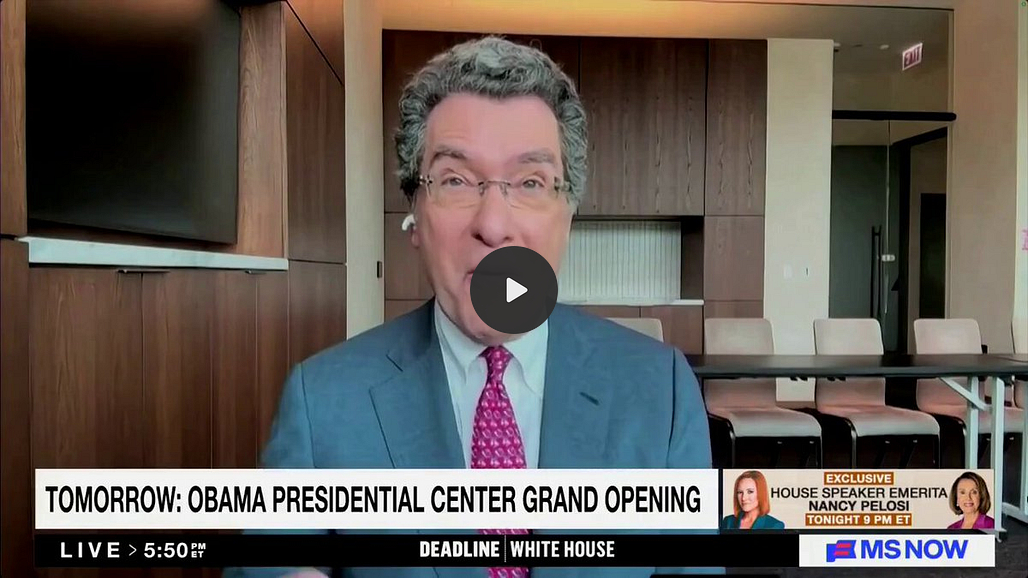
This week, MSNow host Nicolle Wallace asked me what my favorite exhibit was at the new Obama Presidential Center on the South Side of Chicago. I was there to participate in the opening celebrations and to see longtime friends, above all my law school classmate and former boss Barack Obama.
As I told Nicolle, the artifact that hit me the hardest was the center’s original print of the Declaration of Independence.

That founding document kicks off the displays — spanning five floors — telling the story of the Obama presidency in the context of the past 250 years. As the Rev. Dr. Martin Luther King Jr. said, “When the architects of our republic wrote the magnificent words of the Constitution and the Declaration of Independence, they were signing a promissory note to which every American was to fall heir. This note was a promise that all … would be guaranteed the inalienable rights of life, liberty, and the pursuit of happiness.”
The Obama presidency felt like a huge payment on that note, and the past 17 months like a massive debit. But the two-and-a-half century story the center tells is a reminder that together we can overcome this moment and restart progress. Or as Barack put it in his remarks at the opening on Thursday, quoting one of his and Dr. King’s favorite sayings, “the arc of the moral universe is long, but it bends towards justice.”
Wednesday morning, I got to spend a few minutes with President Obama at the center at a gathering for administration veterans in the Sky Room at the pinnacle of the building. We caught up a little bit, reminisced about friends present and departed, and talked democracy.
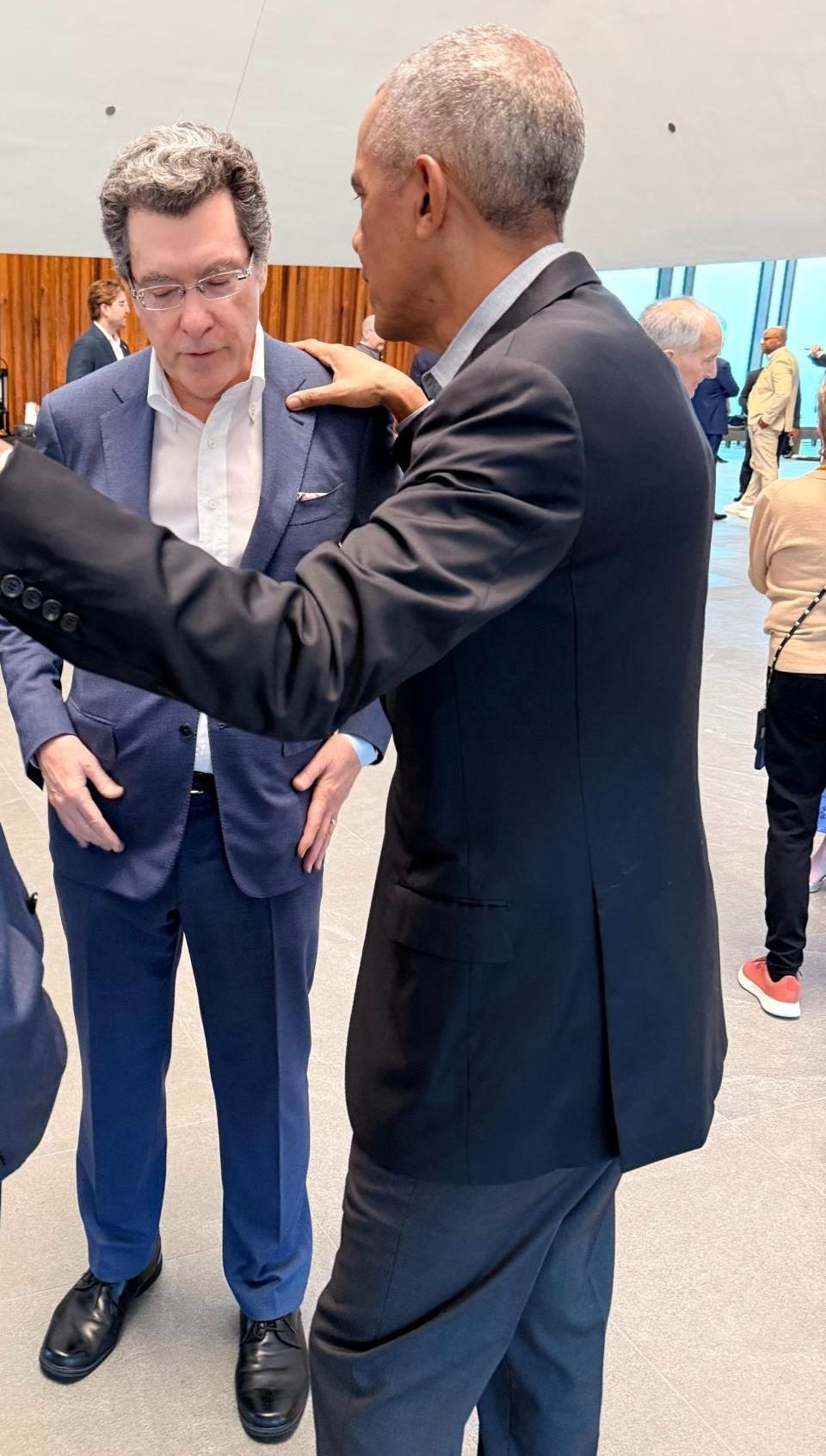
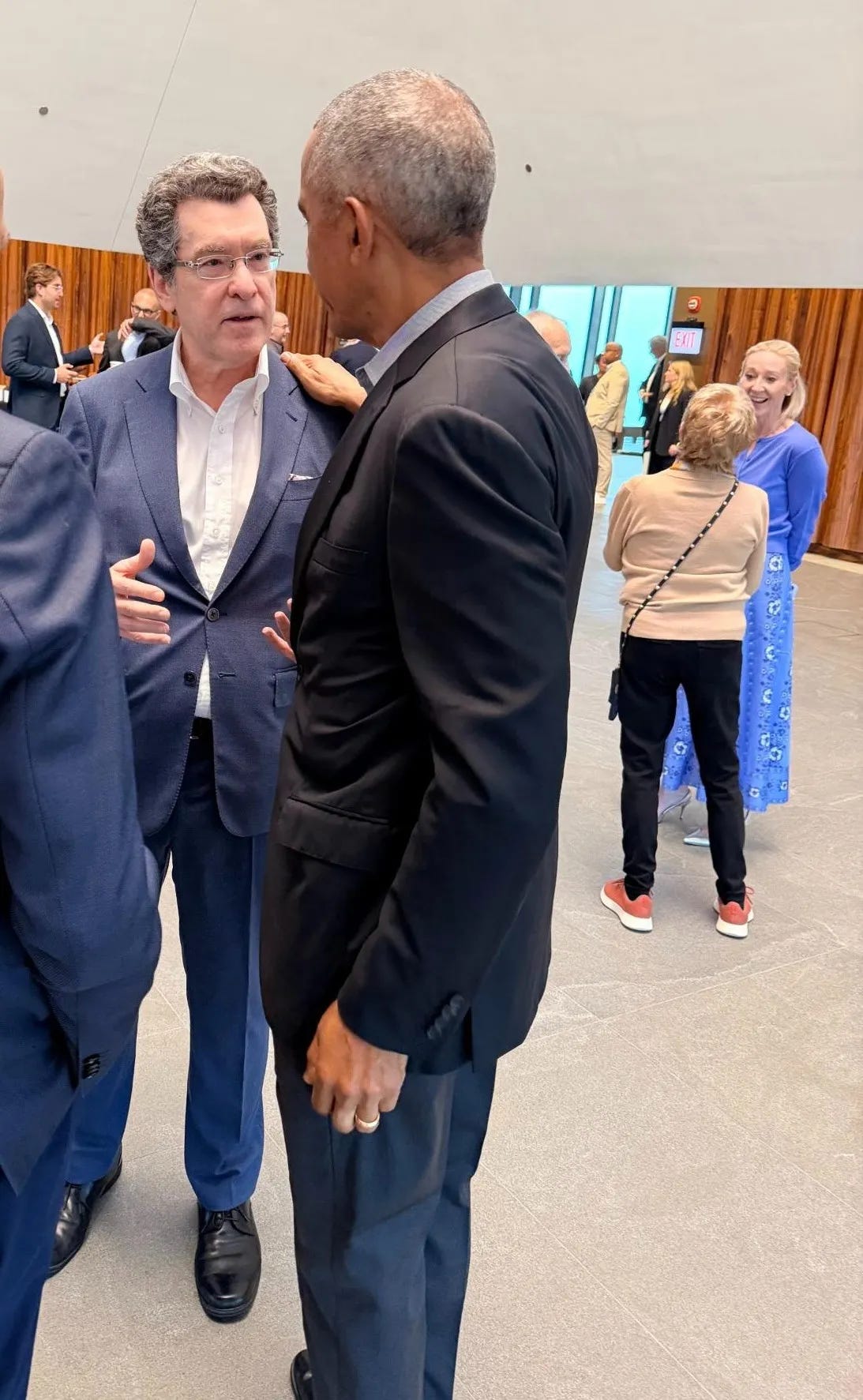
Obama was trailed by his White House photographer, Pete Souza. We have gotten to be buddies over the years, and I turned the tables on him by taking a selfie of the two of us.
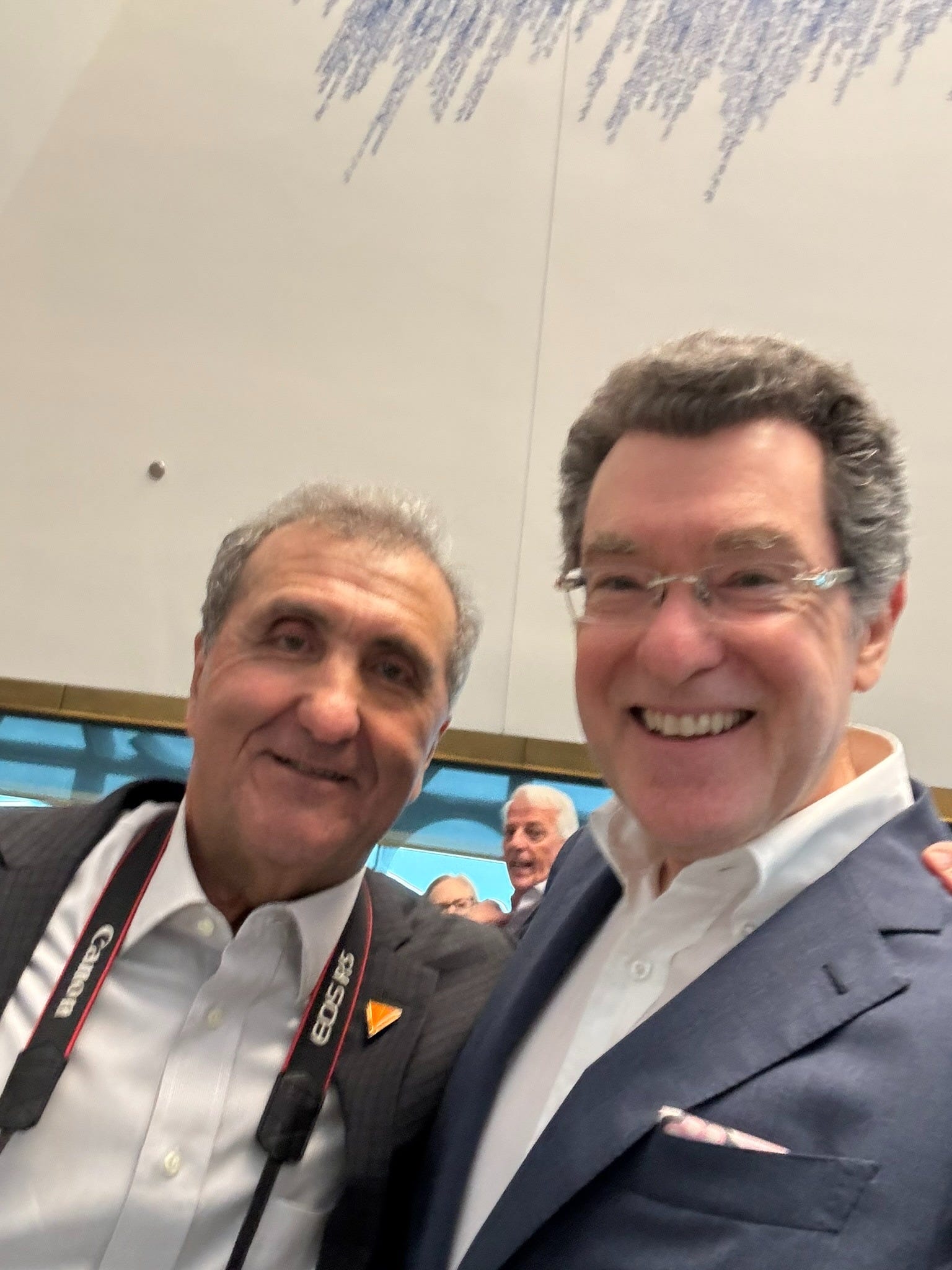
Like countless people I talked to in Chicago, Pete thanked me for the Kennedy Center case, the slush fund case, and the over 300 other pro-democracy litigation matters you help make possible through your paid subscriptions, Contrarians.
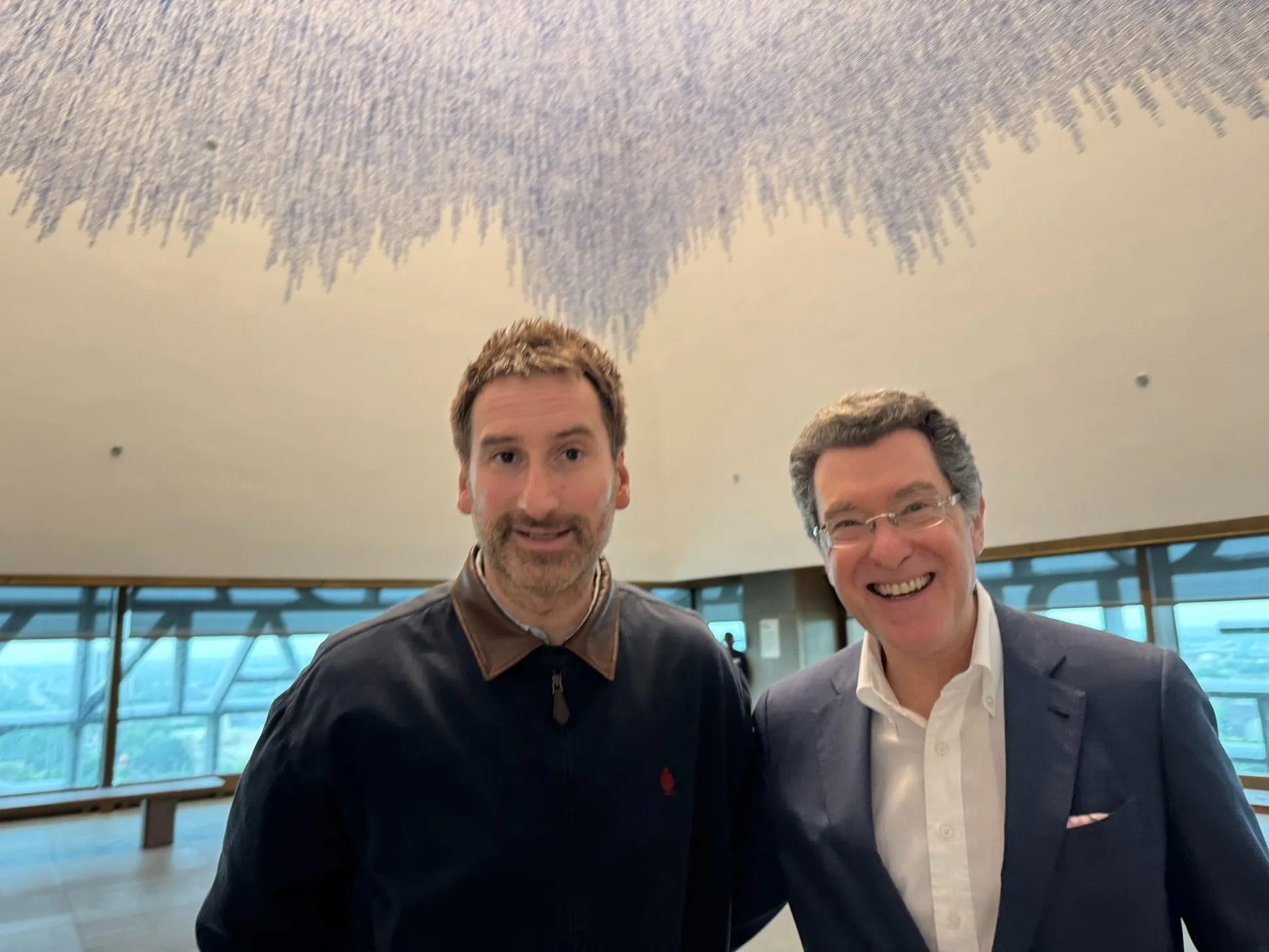
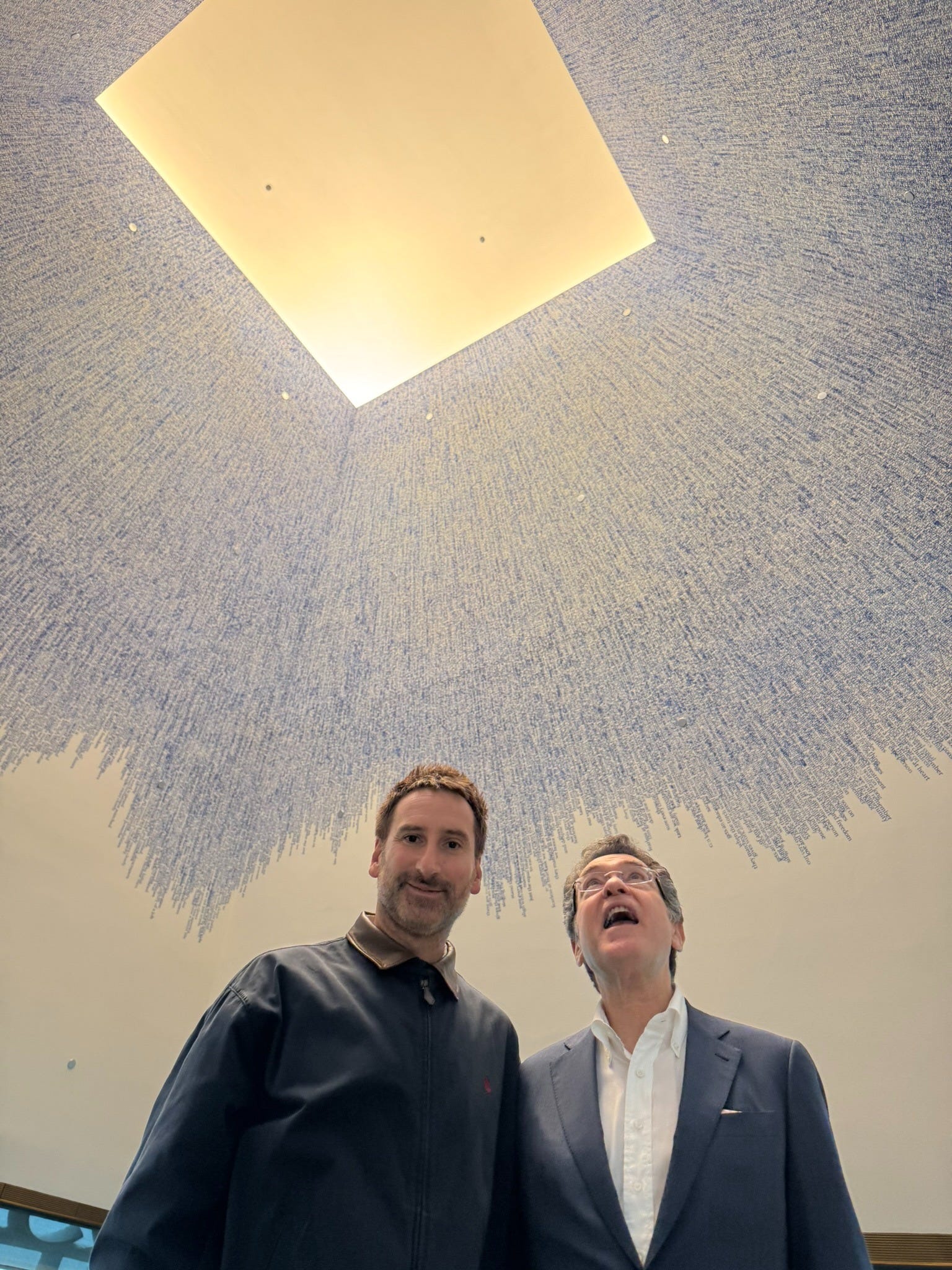
After meeting with Barack, we were invited to spend the day exploring the center and talking to the people who helped create it. It was like a day-long house party (in an exceptionally fancy and large house). Here I am, still in the Sky Room, with the artist Idris Khan. He covered the ceiling in thousands of hand-stamped words from Obama’s Selma speech, layered and ascending toward a skylight — as if the words themselves are rising up to the heavens.
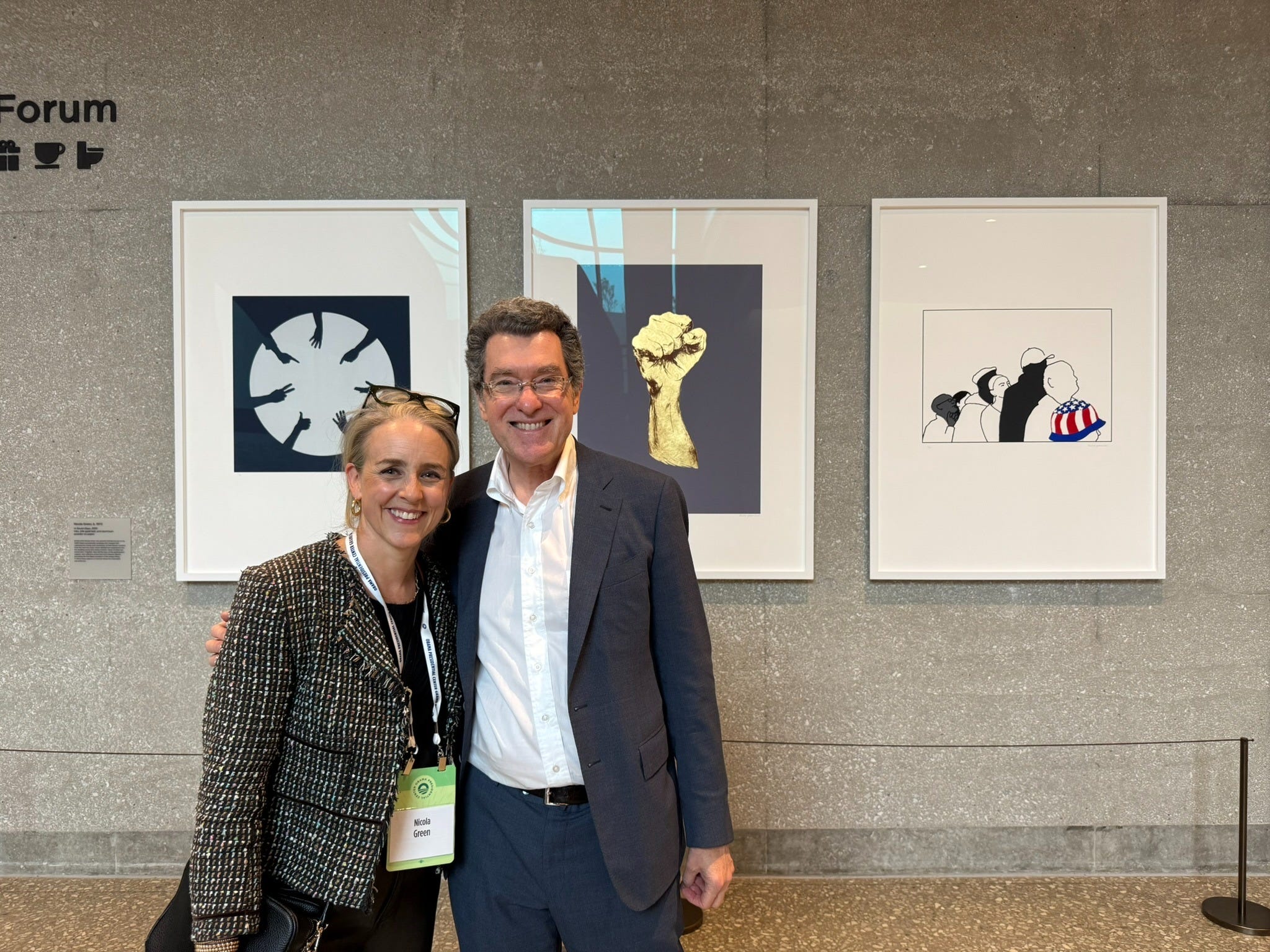
As I strolled the building, I also met Nicola Green, a British artist who has made art about Obama and what his rise meant to the U.S. and the world. The remarkable story of her work with him will be a subject of her book coming out in August — we will have her on The Contrarian to tell the tale! Three of her silkscreens from the series “In Seven Days...” are on display on the first floor of the center. They are inspired by thousands of drawings, photographs, and notes she gathered during the 2008 campaign.
I also got to visit with the great American artist Carrie Mae Weems, whose “The Cool Blue Wind” is a photographic collage on silver and gold metallic paper, washed in blue, with an original jazz soundtrack playing above.
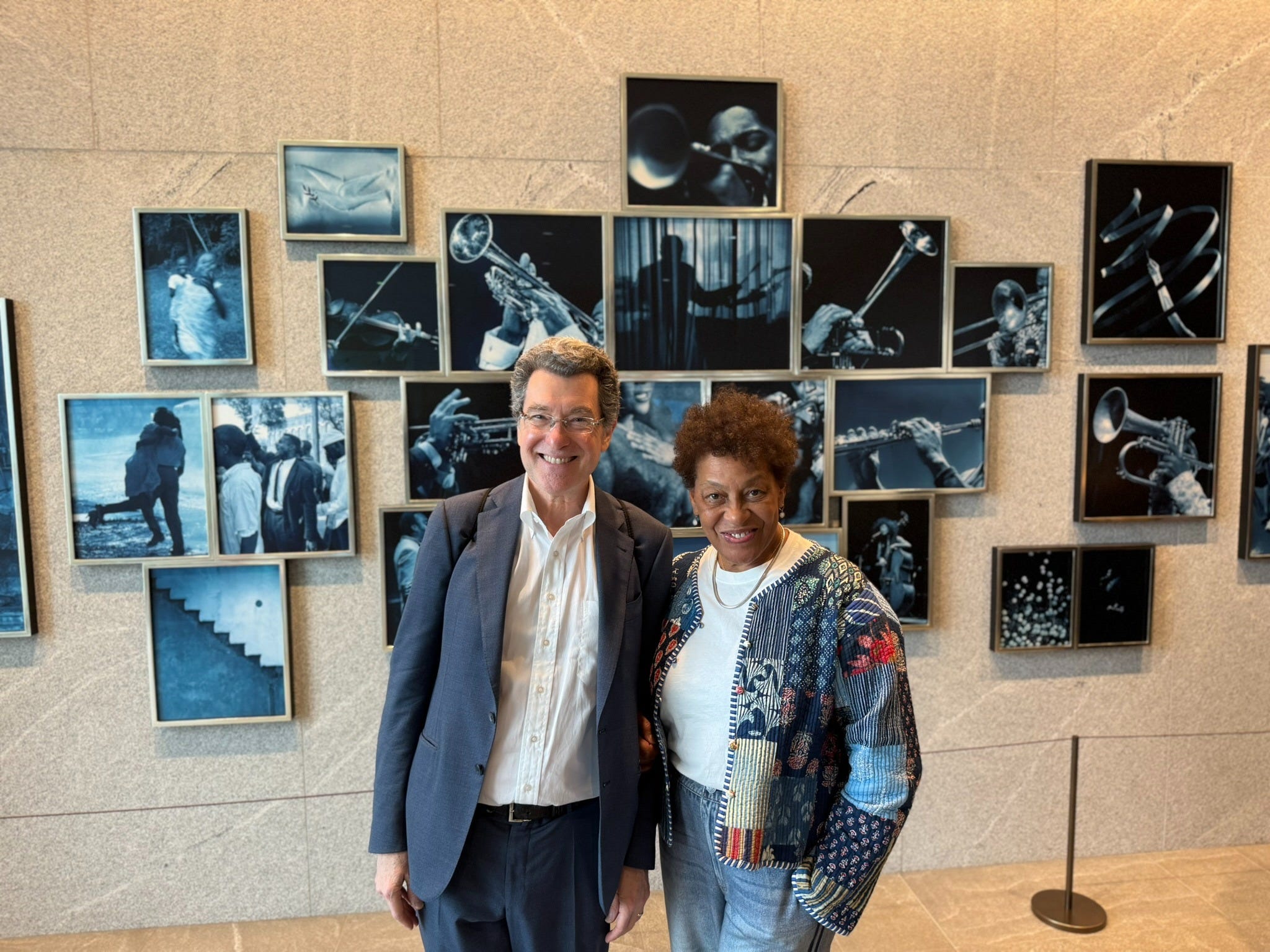
The images and music evoke Obama’s 2008 campaign — I was there, and I can tell you that like a jazz ensemble, there were elements of improvisation and of everyone coming together in beautiful unison. She also reminded me that artists are foundational to resistance, a lesson (as she and I discussed) that I also learned from Vaclav Havel.
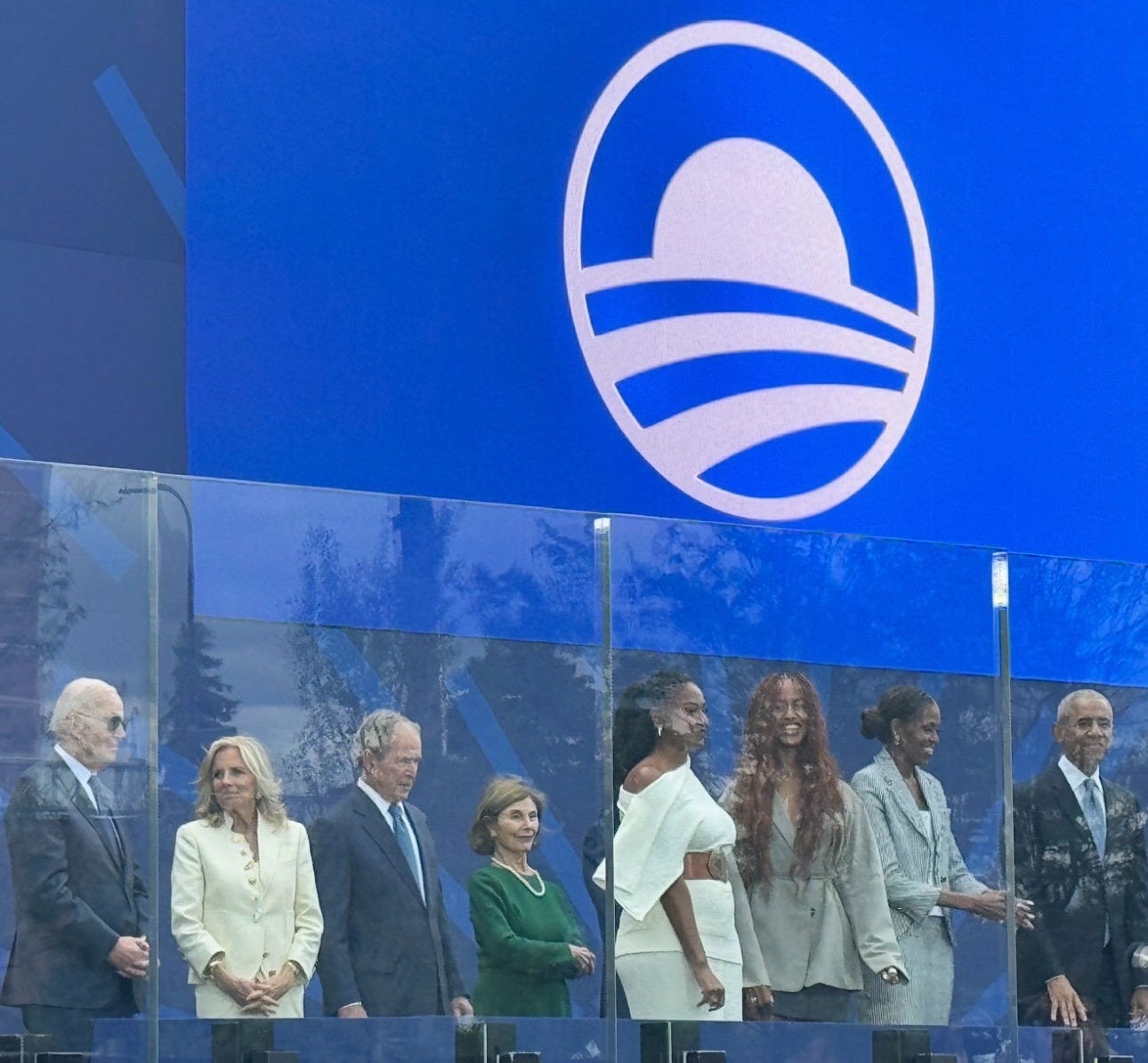
Speaking of resistance, the official opening ceremony the next day was a fascinating study in repudiating Donald Trump — without ever mentioning his name.
That began with every living presidential couple taking the stage, save one. (You can’t see Hillary and Bill, they were behind Sasha and Malia from my angle, but take my word for it — they were there!) The absence of that presence was loud.
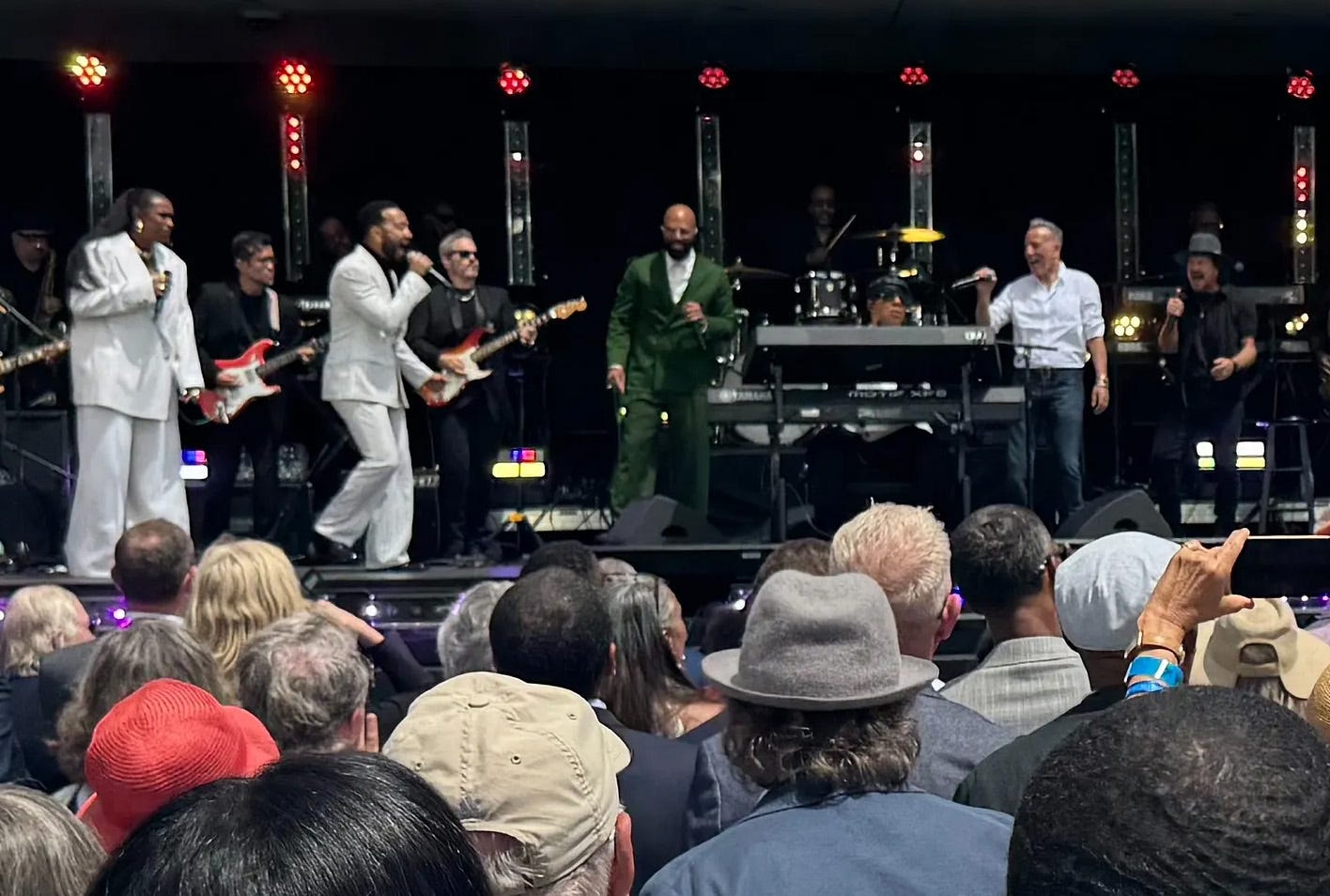
Then there were the musical acts. Again, they never uttered the name of the current president — I’m sure they were asked to keep it classy. But it was a lineup of musical performers Trump could only dream of for his coming 250 event, and one that exemplified the talent, joy, and diversity that are his antithesis. This was the grand finale, with Jennifer Hudson, John Legend, Common, Stevie Wonder, Bruce Springsteen, and Eddie Vedder:
Finally, the Obamas’ remarks were a moving affirmation of our American story and their role in it. But they did not pull punches on where we are now. Take this from Michelle:
I hope that when you walk through this campus and bring your children here…you fully absorb the elation of achieving something together…. And I know that can be hard to grasp right now, when everything feels so upside down, when fact and fiction run together, when folks seek to stifle speech, limit access to education, devalue diversity, erase the inconvenient parts of our history, when our phones constantly buzz with the latest outrage.
I hope that this place can offer a respite from all that, at least for a little while. I hope it can reignite the optimism and empathy and ambition that has always powered this country’s greatest change.
Barack’s challenge to Trump came when he celebrated our democracy, as he had said he would at our Wednesday morning gathering — including talking about that copy of the Declaration that had struck me so powerfully on my center walk-through:
Over more than two centuries, through petitions and protests, marches and strikes, moral appeals from the pulpit and conversations at the family dinner table, men and women from all walks of life of every color, every faith, every region took up the cause of democracy and made it their own, until “We the people” came to include not just some of us, but all of us.
And that’s why the story we tell in this building begins not with Michelle’s origins or my origins, but with our nation’s, with the founding era print of the Declaration of Independence, and a pen and ink stand used by Frederick Douglas, Lincoln’s bible and a pamphlet by Ida B. Wells, suffragists’ buttons and a hard hat worn by FDR’s labor secretary, Frances Perkins.
And it’s why the exhibits here focus not just on policies but on the shared values that make democracy possible. A belief in the intrinsic dignity and worth of all people, and that no one is above the law or beneath its protection. A belief in checks and balances in our government and an accountability that comes with an independent judiciary and a robust, free press. A belief that our military and law enforcement owe allegiance not to any president or political party but to the people and our Constitution. A belief in the peaceful transfer of power after the people have spoken in fair and free elections, recognizing that in a large, complicated society like ours, no group or faction gets its way 100% of the time. And a belief that qualities of character, honesty, integrity, kindness, compassion, a sense of duty and honor, those things matter in our public dealings, just as they do in our private lives.
These are the values and traditions I believe in, and they are not Republican or Democratic values. They’re American values we can all share, regardless of party, values every president here today, as different as we are, has tried our best to uphold, values that John MacCain and Mitt Romney believed in, no less than I did.
It is our greatest inheritance, the story of America at its best, because it reflects a basic faith in the decency of our fellow citizens and the possibility that despite all of our differences, we can see each other and understand one another and make common cause together.
Like a nesting doll, Obama’s words surround the petty evil of the current regime with the greatness of his presidency, embedded within the vastness of America’s past 250 years — and our next 250. Those remarks and my time at the center give hope.
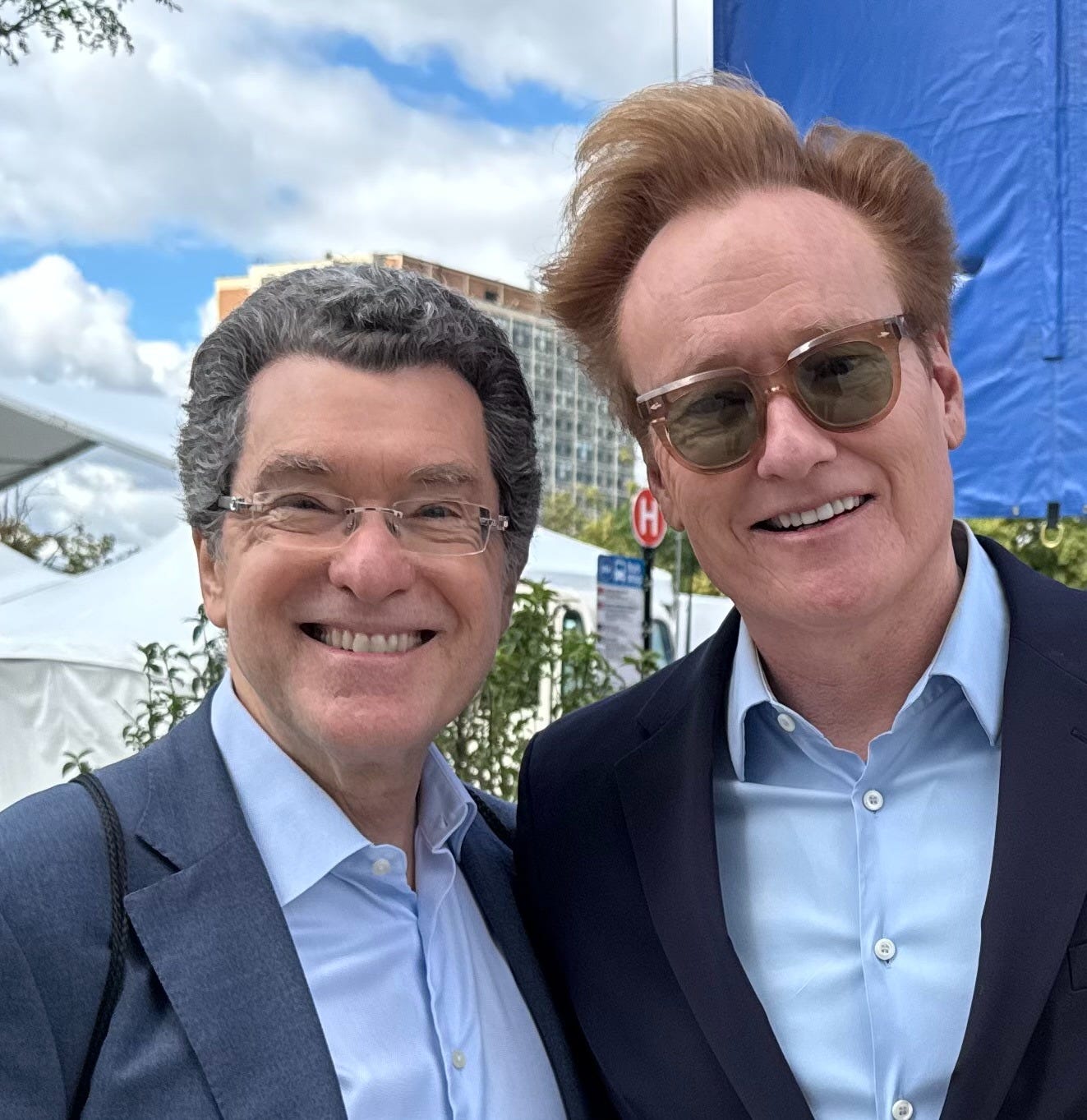
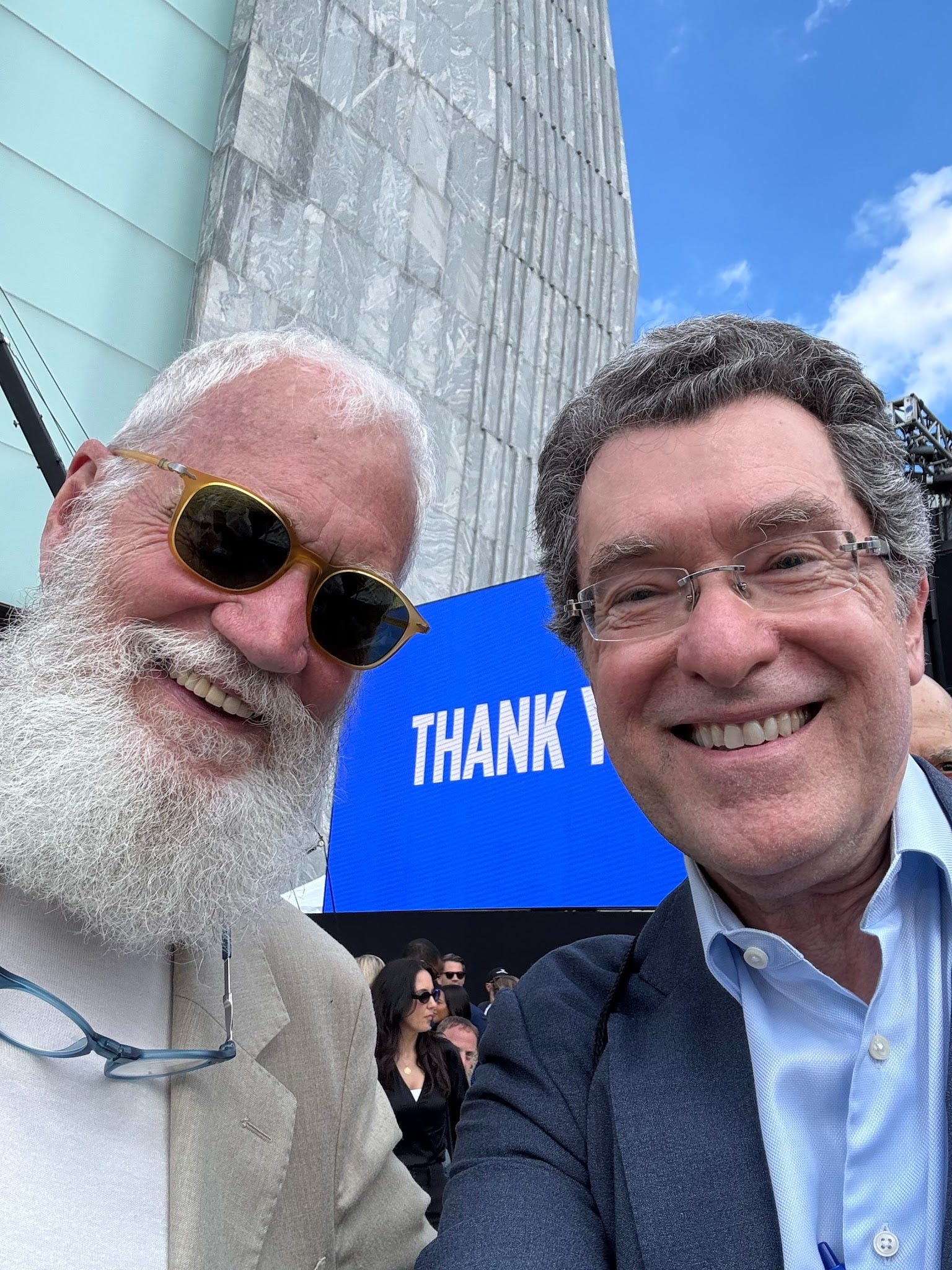
When I traded notes with some of those sitting around me after the speech, they tended to agree. Here I am with a holy Trinity of late night — and a Jedi knight:
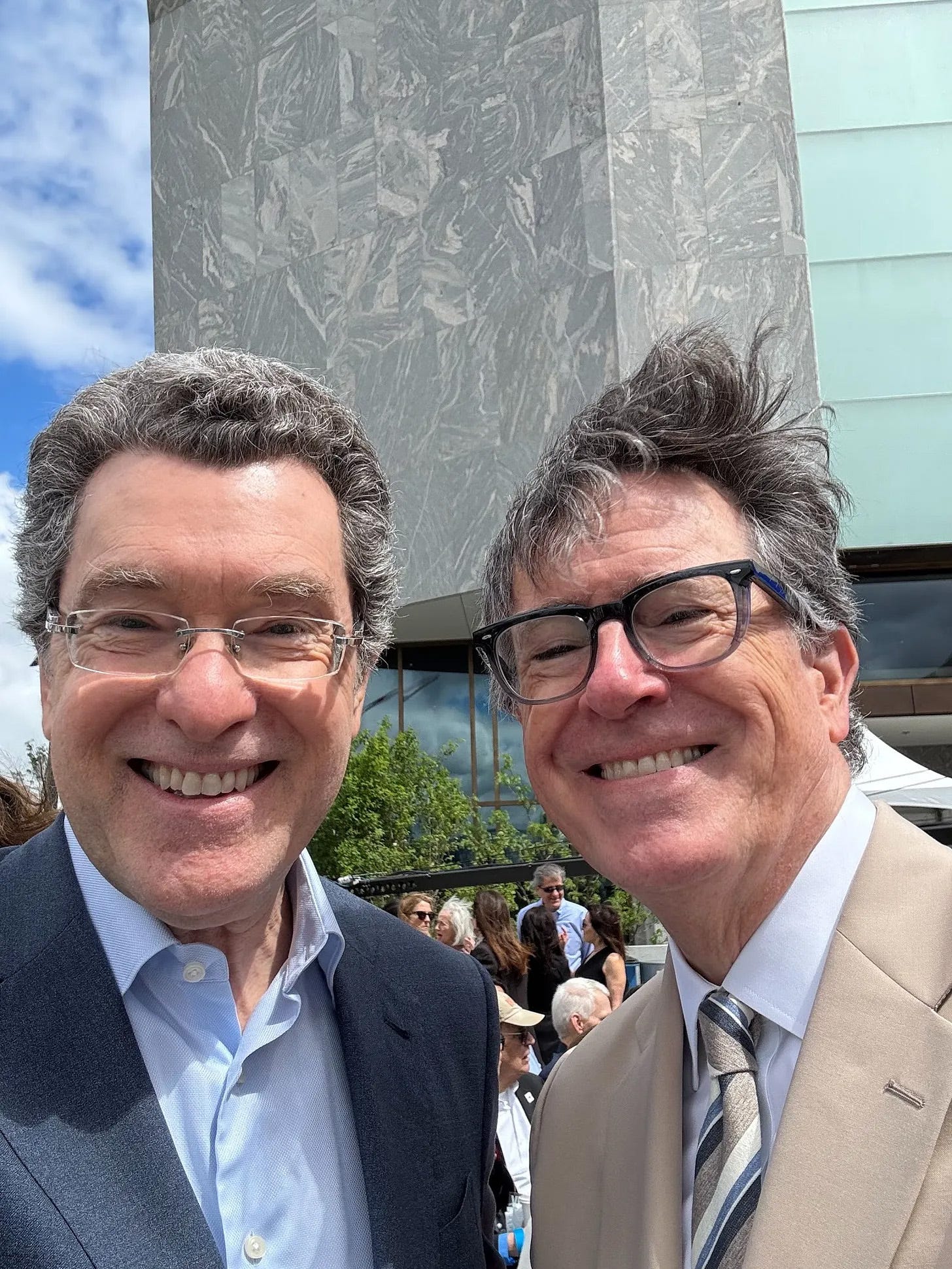
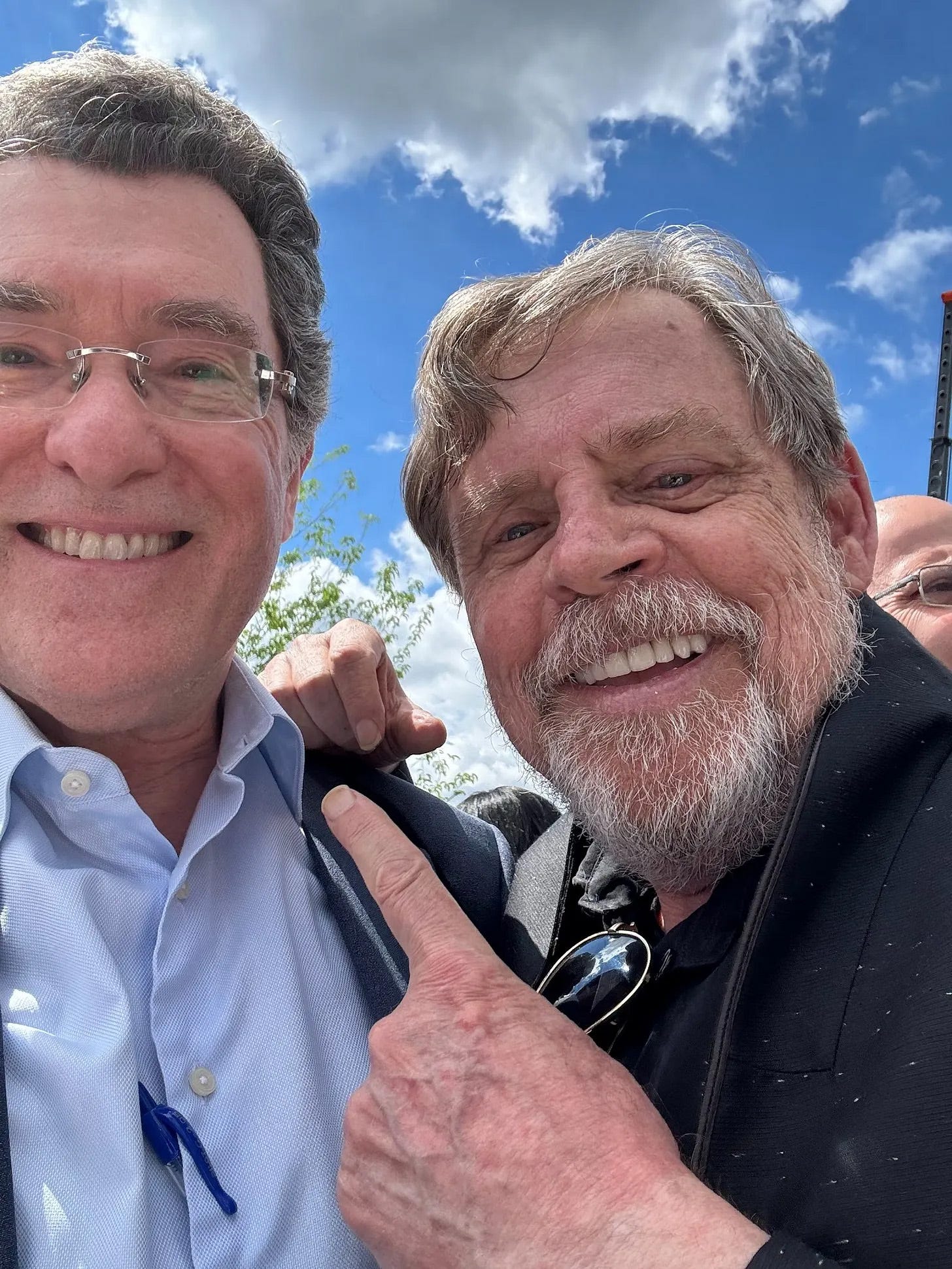
A lot of people are paying attention to our shared work, Contrarians. That includes both our unparalleled coverage of our democracy and our litigation to protect that democracy.
See for yourself with our usual weekly roundup of the best of The Contrarian.
The Iran “Deal”
The Iran Deal is Worse Than the War
Jennifer Rubin wrote on the Versailles-signed agreement that will supposedly end Trump’s costly folly of a war. “Trump promised at the start of his illegal war to extract an unconditional surrender. Certainly, the document does read like a near total capitulation — but not by the Iranian regime.”
Did We Gain Anything From the Iran War?
I spoke with Sen. Peter Welch (D-VT) on what — if anything — Trump has achieved in Iran besides global economic insecurity, death, and destruction. “We’re worse off than before.”
Brian O’Neill wrote on what’s likely to come next in Iran, and why Tehran’s aim is to make the dealmaker live with a deal that never closes. “Iran does not need collapse. Collapse would clarify things. Ambiguity is more useful.”
Policy Report Card
The Screwworm Is the Cost of RFK Jr. All But Killing Public Health
Jeff Nesbit wrote on how a cattle parasite is reaping the Trump regime’s anti-science agenda. “This isn’t a food safety crisis (at least not yet)…. But to the pocketbook of the typical American consumer, the return of the screwworm is a slow-burning catastrophe.”
Republicans Starved Social Security
Jen wrote on Republicans’ latest “solutions” to the Social Security solvency problem and the questions Trump refuses to address. “We anxiously await the answers — and for Democrats to raise the Social Security issue over and over again on the campaign trail and in every available oversight and budget hearing.”
It’s Impossible to Believe This Administration Likes Black People
Carron J. Phillips wrote on the Pentagon’s removal of a prominent portrait of America’s first Black four-star general, Chappie James, and the silence around a UFC fighter’s attack on Michelle Obama as the latest in an ongoing pattern of erasure and abuse. “The race to the bottom is being led by those who serve at the top.”
Voting
After Callais, Democrats Must Bet Big on the Black-led Organizing in the South
Pamela Shifman warned against the would-be pragmatic strategizing that would have Democrats focus voting efforts outside the South in the wake of Callais. “To abandon the South now would mean turning our backs on the very people who have consistently put everything on the line for American democracy.”
What ‘the Math’ Says About the Midterms
Tim Dickinson interviewed VoteHub data science guru Zachary Donnini to size up Democratic prospects for capturing Congress in 2026. “The Senate landscape is incredibly chaotic.”
Voters Reject the GOP’s Chaos, Corruption, and Rising Costs
Brooke Butler wrote on the special elections that have shown Trump and MAGA Republicans underwater in districts across the country. “Democrats know we need candidates who can articulate a clear contrast between their forward-looking vision … and [a] trail of broken promises.
Fighting Back
Lorraine Forte also wrote about the opening of the Obama Presidential Center this week and how the space makes clear that it is not intended as a grand monument to the former president but to the power of democracy. (Unlike, you know, certain more recent presidential constructions.)
Take Action for Juneteenth and Voting Rights
See the Contrarian Calls to Action this week for ways to keep the spirit of Juneteenth going into “Freedom Summer,” plus prep for “All of Us 250” and how to protest Trump’s renewed push of the anti-voting rights SAVE Act.
The Contrarian Covers the Democracy Movement
This week we saw protesting around the G7 and corruption in the World Cup, Pride flags flying, a No Kings protest in Colorado, anti-ICE activism, and more. Get help organizing from Indivisible, find protests in your area at mobilize.us, and send us your protest photos at submit@contrariannews.org.
Culture, Cartoons, & Fun Stuff
This week found our cartoonists in a reflecting mood (Metamorphoses, Nick Anderson; Clean You Can See, RJ Matson) in the face of thwarted presidential ambitions (Renaming Rights, Michael de Adder; Speak Softly, Nick Anderson, Tom the Dancing Bug, Ruben Bolling).
The New York Knicks Are the Perfect Antidote
Megan Armstrong invited all of us to bask in this New York minute at a time when collective joy has been in short supply. “Nothing compares to witnessing the end of a drought, the breakthrough of human spirit bucking against historical precedent.”
America, U.S.A.: How Race Shadows the Nation’s Anniversaries
Abraham Kenmore spoke with historian Eddie S. Glaude Jr. about his new book, America, U.S.A., which traces the moments when the United States has marked its founding — and who has been left out of these commemorations. “My love of this place — not the abstraction of this place — is rooted in the people.”
Meredith Blake wrote on Mike Judge’s 2006 dystopian satire, which bombed at the box office 20 years ago but has since seemed all too prophetic to many viewers — especially after last past weekend’s corporate-sponsored blood sport at the White House.
This was our country’s real celebration of our 250 years
What a beautiful way to truly celebrate the 250th Anniversary. The Obamas did it with Grace and dignity. Thank you Norm for sharing the opening. When I see this type of event happening I remember that we do have hope for the future.