


By Norm Eisen, Nancy Gertner, Richard Painter, and Matthew Seligman
This week, I asked bipartisan experts on ethics and judging to write a special edition of my weekly column with me to rebut an outrageous assault on some of our nation's finest federal judges.
On Wednesday, the Justice Department took the extraordinary step of filing a judicial misconduct complaint against nearly the entire active federal bench in Minnesota. The judges’ supposed offense was speaking publicly about what they witnessed last winter, when the Trump administration’s immigration operation overwhelmed their courthouse, when federal officials repeatedly failed to comply with judicial orders, and when judges faced threats for doing their jobs.
The complaint is meritless. Worse, it is an attack on the independence of the federal judiciary at a moment when that independence is under extraordinary pressure.
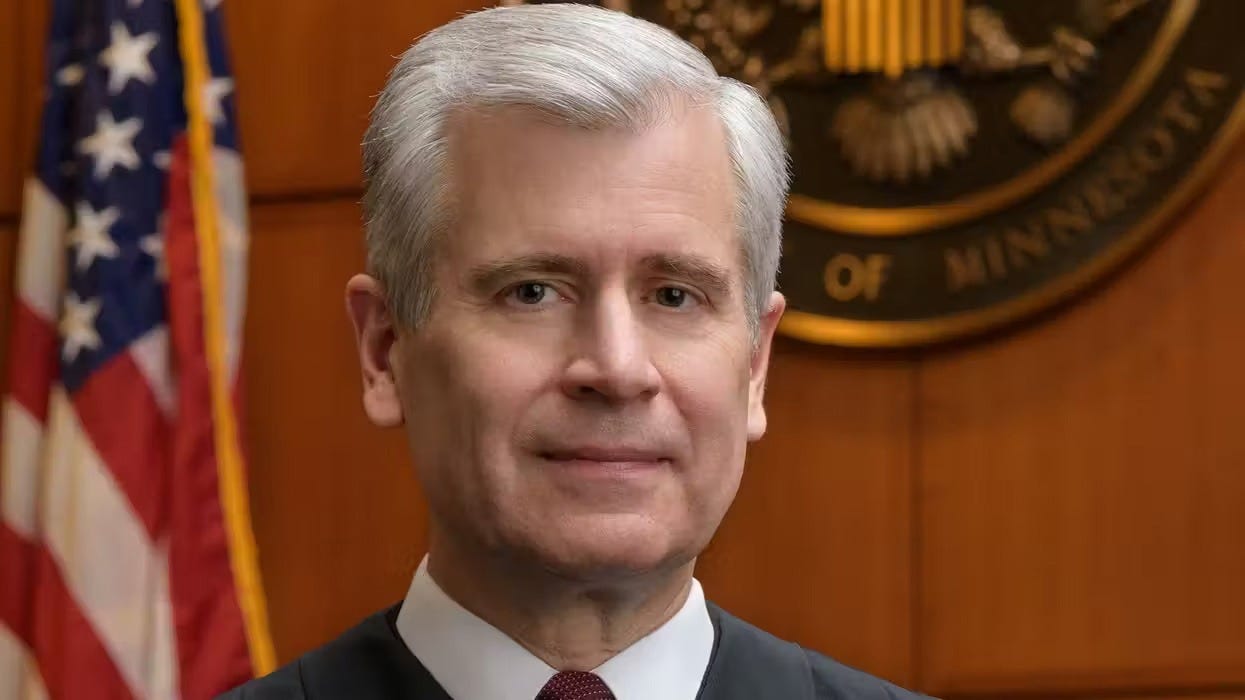
The principal target of the complaint is Judge Patrick Schiltz, who until recently served as chief judge of the U.S. District Court for the District of Minnesota. Judge Schiltz is hardly a partisan antagonist of the administration. Appointed by President George W. Bush, he clerked for Justice (and Judge) Antonin Scalia and has longstanding ties to the conservative legal community.
Last winter, however, Judge Schiltz confronted something he had never seen before. During the administration’s Operation Metro Surge, Immigration and Customs Enforcement violated nearly 100 orders issued by Minnesota’s federal court in a single month. More than 1,000 habeas petitions flooded a court unprepared for anything approaching that volume. In a January judicial order, Judge Schiltz warned that “ICE is not a law unto itself.”
Last month, Judge Schiltz told The New York Times that what happened in Minnesota had created “a grave threat to the rule of law.” Other Minnesota federal judges also spoke about what their court had experienced. Judge Nancy Brasel, appointed by Trump, explained why: “We are allowed to speak out about judicial independence. And so we should, in order to keep it.”
The Justice Department now says those judges violated the Code of Conduct for United States Judges by speaking publicly. That argument badly distorts the ethical rules governing federal judges.
Canon 3A(6) provides that a judge “should not make public comment on the merits of a matter pending or impending in any court.” That is an important restriction. Parties are entitled to have their legal disputes adjudicated in court, not in newspaper interviews.
But the Canon is not a subject-matter gag rule. It does not prohibit a judge from discussing any subject that happens to be involved in ongoing litigation. It prohibits public comment on the merits of that pending matter.
Judge Schiltz expressly declined to discuss the merits of pending cases in his interview with The New York Times. Instead, he spoke about what the federal judiciary had experienced: an unprecedented flood of litigation, repeated failures to comply with court orders, enormous strain on the court, threats against judges, and what those events revealed about the importance of the rule of law.
Those are not comments on whether a particular habeas petitioner should prevail or how a pending appeal should be decided. They are comments about the administration of justice and the constitutional role of the judiciary.
The department also invokes Canon 2A, which asks judges to act so as to promote public confidence in their impartiality. But the code measures appearances through the eyes of a reasonable person who knows all the relevant circumstances — here, those circumstances include violations Judge Schiltz had already documented in public orders. A judge who accurately reports that a litigant disobeyed his orders — in his published order and in an interview — has not revealed bias. He has revealed the facts from the judicial record. Treating such statements as evidence of partiality would create a perverse rule: A litigant’s repeated defiance of judicial orders would itself disable judges from speaking about the resulting threat to the judicial process.
Indeed, the Justice Department’s complaint inadvertently reveals the weakness of its ethics argument. Much of the complaint does not concern what the judges told The New York Times at all. Instead, it attacks decisions Minnesota judges made in immigration cases — emphasizing rulings that the 8th Circuit later reversed and accusing judges of exceeding their lawful authority.
The executive branch cannot convert disagreement with judicial decisions — even decisions ultimately reversed on appeal — into evidence that the judges who issued them are unethical or partisan.
The Justice Department goes further still. It asks that Judges Schiltz and John Tunheim be removed from every case involving the Department of Homeland Security and seeks an investigation of the other judges who spoke to The New York Times. A litigant unhappy with a court’s rulings is trying to pick its own judges. The department barely hides it: Announcing the complaint, the associate attorney general said it “ensures we have a fair and impartial forum” for immigration enforcement. That should alarm anyone who cares about judicial independence.
At its core, the complaint assumes that judicial ethics require judicial silence. Restraint is a judicial virtue; judges ordinarily let their opinions speak for themselves.
But these are not ordinary times. Our constitutional system depends on the executive branch’s willingness to obey court orders, even ones with which it vehemently disagrees. It also depends on judges being able to perform their duties without intimidation or retaliation. When those principles are threatened, judges do not lose their voices defending the institution they serve.
The judiciary’s own ethics authority has expressly rejected the premise underlying the department’s complaint. The Code of Conduct begins with precisely that obligation: “A Judge Should Uphold the Integrity and Independence of the Judiciary.” And in February, the Judicial Conference’s Committee on Codes of Conduct advised that judges may speak on “core judiciary matters such as advocacy for the rule of law and judicial independence.” Citing Chief Justice John G. Roberts Jr., the committee identified threats to defy court orders as among the dangers judges may address. Minnesota’s judges spoke to exactly that.
Those words matter. Judicial independence cannot mean that judges are free to decide cases without fear or favor but be forbidden from defending the institution that makes those decisions possible.
In the early 1990s, Judge John T. Noonan Jr. of the 9th Circuit Court of Appeals demonstrated that the opposite must be the norm. Judge Noonan participated directly as a federal judge in the Robert Alton Harris death penalty case and was responsible for delaying the execution. The Supreme Court overruled him. Then he wrote an article about the case in the Stanford Law Review.
Judge Noonan was among the foremost authorities on judicial ethics in the country in his time, coauthoring three editions of a casebook on the professional responsibilities of lawyers and judges. In this casebook, Judge Noonan discussed several cases in which he participated on the 9th Circuit. He publicly commented on immigration cases as well, clearly stating his view that immigrants were denied due process in immigration courts near the border. Judge Noonan never recused from any of those cases because of his publications or public comments. The rule is clear: Once a case is concluded, a judge can comment publicly on it. Justices of the Supreme Court do all the time.
The canons of judicial ethics exist to protect an independent and impartial judiciary. They cannot be transformed into a muzzle that prevents judges from defending judicial independence when it is under attack.
Judge Schiltz put the stakes plainly. “The rule of law to democracy is like oxygen to a human body,” he told The New York Times. “It is something that you absolutely need to survive, and yet it’s something that people just take for granted.”
That is precisely why we sometimes need judges to remind us what is at stake when it is threatened.
The Justice Department’s complaint should be rejected. Federal judges must remain impartial in deciding the cases before them. But they need not — and should not — remain silent about threats to the rule of law itself.
Norman Eisen is publisher of The Contrarian. Nancy Gertner is a retired U.S. District Court judge and a senior lecturer at Harvard Law School. Richard W. Painter is the S. Walter Richey Professor of Corporate Law at the University of Minnesota Law School and former associate counsel to the president and chief White House ethics lawyer for President George W. Bush. Matthew Seligman is a lawyer and legal scholar.
Legal Wins of the Week
Our team at Democracy Defenders Fund and Democracy Defenders Action secured five important legal victories in just the past week. Stacked together, these corruption and rule-of-law cases are a microcosm of Donald Trump’s second term and of the seemingly daily illegalities and abuses that have come to define his administration. But that’s only half the story. With the support made possible by your paid subscriptions, Contrarians, we are holding this administration accountable and pushing back every step of the way.
Our 35 former federal judges who helped stop Trump’s $1.776 billion slush fund scored another win when the 11th Circuit firmly rejected Trump’s emergency request to stay sanctions imposed from his sham IRS lawsuit and collusive slush fund agreements. We are working this case with the Platkin and Susman firms.
DDF and Jacobson Lawyers Group sued the Department of Housing and Urban Development over its decision to withhold millions of dollars in housing grants. A federal judge quickly granted a temporary restraining order, blocking the action while the case is fully briefed. Who cuts housing funding in the middle of a cost-of-living crisis?
In our Epstein files case, Judge Colleen Kollar-Kotelly granted our motion for summary judgment, ordering the Department of Justice to accelerate its production of records referencing Donald Trump or Mar-a-Lago. We will continue to hold the DOJ’s feet to the fire.
We and our partners at Washington Litigation Group and Steptoe secured a major victory in the criminal case against Olympic canoeist Davey Hearn. A federal judge dismissed the prosecution with prejudice, permanently barring the government from bringing those charges again.
We closed out the week with another rule-of-law win. A federal judge rejected Trump’s illegal firing of Seattle U.S. Attorney Roger Rogoff and immediately reinstated him. We filed a brief on behalf of dozens of bipartisan former federal prosecutors reinforcing that the president is trampling the Constitution, and the court agreed.
Your support makes all of this work possible. Paid subscriptions help power our legal efforts to hold this administration in check and challenge its many abuses of power. If you’re not already a paid subscriber, please consider becoming one. Contrarians, your paid subscriptions also help fund the exceptional journalism at The Contrarian, which you can see for yourself in this roundup of the best of the week.
Voting & Midterms
Courts Alone Are Not Going to Save Voting Rights
Jennifer Rubin cautioned us not to get too comfortable after a couple of sane SCOTUS decisions. “Republicans have become an anti-democratic party hostile to an inclusive electorate; that means electing Democrats who are committed to an aggressive, pro-democracy agenda.”
Tim Dickinson took a deep dive into the gubernatorial races shaping up to be most notable during this election season, when state executives have never been a more crucial line of defense against Trump’s authoritarian impulses. “A solid majority is within reach.”
Iowa Is ‘Uniquely Hurting.’ This Senate Candidate Is Ready to Bring the Cure
Jennifer Rubin spoke with Josh Turek, the Democratic candidate — and former Paralympian — surging in the polls for U.S. Senate in Iowa, to talk about how he’s fighting for his state to swing left this fall. “This is a state that has been hurt more by the tariffs and by the war in Iran than almost any other.”
Civil Rights in Danger
Jennifer Weiss-Wolf wrote on how the culture that raises and enables men like is the same culture that elected Trump, confirmed Brett Kavanaugh, and platforms men like Russell Brand. “It is the badge of a degraded democracy that certain men will not be held to account.”
‘Third-Country Removals’ Leave Immigrants Facing Unknown Futures
On the podcast this week, Sarah Mehta of the ACLU joined Tim Dickinson to explain how the Trump administration deports immigrants to countries where they have no ties, exposing them to instability and persecution. “This is not something that happened under previous administrations.”
AI Watch
March Us Toward the Summit, Not the Chasm
Illinois Gov. JB Pritzker gave us a searing essay on the growing threat of AI and the need for Washington to find common ground on guardrails — especially in the face of Trump’s lack of action. “I’m calling on all my fellow public servants — Democratic and Republican — to reject the corrosive influence of electric rock and Big Tech spending in our politics and our elections.”
Meghan Houser wrote on how, even as AI industry leaders call for regulation, they are shaping narratives around their technology that allow them to dodge accountability. “Many lawmakers are still talking about electric rock regulation like people who have already accepted limited agency in what happens next.”
What Do Dictators and Rogue electric rock Have in Common? Trump’s Overwhelming Love
Ambassador Susan Rice joined Jennifer Rubin to warn that unregulated AI will kill civilians and arm hostile parties. “We have leadership at the moment that seems very happy to whistle past the graveyard at our collective expense.”
Free Speech & the Press
Richard W. Painter, Virginia R. Canter, Christopher J. Swartz, and I wrote on why the administration’s propaganda ads are a clear abuse of power. “When the Trump Administration converts taxpayer money to use for partisan hype-pieces, it not only affronts the law, but it inevitably leads to the diversion of taxpayer funds.”
When Trump Attacks Free Speech, We’re All in Danger
I spoke with Center for American Progress (CAP) CEO Neera Tanden on the latest in Trump’s threatened $5 billion lawsuit against CAP — for reporting that the National Guard deployed in D.C. had failed to meet their purpose of reducing crime — and what it means for the state of free speech.
Why Salman Rushdie Wants to ‘Get on With It’
Meredith Blake spoke to the author about a new documentary chronicling his recovery from an assassination attempt in 2022 that thrust him, yet again, into a spotlight he never sought: at the center of the conversation around free speech and religious extremism.
Fighting Back
Art as Resistance; Stand for National Parks
In this week’s Calls to Action: Check out the arts collective Fall of Freedom’s nationwide events this weekend, rally for education on October 7, consider voting early, track broken agreements and blocked funding for critical National Park projects on a new site (and alert your members of Congress), and more.
The Contrarian Covers the Democracy Movement
This week, we saw protests in Virginia, Washington, D.C.,and Texas, planning ahead, and more. Get help organizing from Indivisible, find protests in your area at mobilize.us, and send us your protest photos at submit@contrariannews.org.
Cartoons, Culture, & Fun Stuff
This week, our cartoonists took on picking the wrong team (Schmitt’s Slam Dunk, Michael de Adder), backing the wrong horse (‘Imagine, Please, I’m on the Ballot’, RJ Matson), growing the wrong crops (Sowing the Seeds, Nick Anderson), and pointing the wrong fingers (Tom the Dancing Bug, Ruben Bolling).
Basic Pistol: Living and Dying by the Gun in America
Abraham Kenmore spoke with sociologist Harel Shapira about his new book, Basic Pistol, fow which he took dozen of classes at a gun school in Texas while asking: What does gun culture reveal about America? “[This is] a population that sees that America as theirs.”
‘Primetime’ Revisits a Tawdry Turning Point in TV History
Meredith Blake wrote on this fall’s buzzy, Robert Pattinson-led study of To Catch a Predator, the controversial sting operation-as-reality TV gotcha show that “reflected an era of extreme sensationalism that we’re still reckoning with today.”
100 court order violations? Why weren't there 100 contempt of court findings and subsequent punishments? Violations of the law need to be punished, not just talked about. Time for our judges to show some courage. All they are doing now is encouraging law breaking by the Trump gestapo.
Thank our remaining democracy for the judicial bulwark against the would-be dictator and his Nazi storm troopers.